Policy / Culture
24 States
Cannabis remains a Schedule I federal controlled substance even as 24 states have legalized recreational use, creating conflicts that affect employment, firearms, immigration, and interstate travel.
Federal Controlled Substances Act; state legalization data, 2026
The State Legalization Map in 2026
covered in detail
Employment and Drug Testing
covered in detail
Cannabis DUI and Driving Laws
covered in detail
Federal Controlled Substances Act; state legalization data, 2026
 View as image ↗
If you only read one thing
Weed is legal in 24 states — but it's still a federal crime. That gap creates real traps. Your employer can probably still fire you for a positive test. You can't fly with it, even between two legal states. If you own guns, you're breaking federal law. If you're not a U.S. citizen, any cannabis involvement can get you deported or permanently banned from the country. 'Legal' doesn't mean 'protected' — and the difference matters more than most people realize.
Important disclaimer: This article is for educational purposes only. It is not legal advice. Cannabis laws change frequently and vary by jurisdiction. If you are facing a specific legal situation involving cannabis, consult a licensed attorney in your state. Nothing in this article should be relied upon as a substitute for qualified legal counsel.
Cannabis law in the United States is a contradiction by design. You can walk into a licensed dispensary in Colorado, buy an ounce of flower with a receipt and a tax stamp, carry it home legally, and still be in violation of federal law the entire time. That is not hyperbole. That is the actual legal framework millions of Americans are navigating right now.
This guide covers the current state of cannabis law as of early 2026, what your rights actually are (and are not), and the specific situations where legal cannabis can still create serious problems for you.
Key Takeaways
- Cannabis is still a Schedule I controlled substance under federal law — putting it in direct conflict with the 24 states plus D.C. that have legalized recreational use as of early 2026
- Employment protections for cannabis users vary wildly by state — some states ban firing workers for legal off-duty use while most still allow drug testing and termination
- Crossing state lines with cannabis is a federal offense no matter what — even if it is legal on both sides — and flying with THC products violates federal law even on domestic flights
- Medical cannabis cardholders are federally banned from buying or owning firearms under 18 U.S.C. 922(g)(3) — a conflict that has survived multiple court challenges
- Immigration consequences are severe — any cannabis involvement, even in a legal state, can result in visa denial, deportation, or permanent inadmissibility for non-citizens
- The DEA's proposed move of cannabis from Schedule I to Schedule III is still pending as of early 2026 — and even if it happens, rescheduling would not legalize cannabis but would ease research rules and lift the Section 280E tax burden on cannabis businesses
Fact Check
'It's legal in my state' vs. what federal law actually says
The claim
“If weed is legal in my state, I'm fully protected — I can use it, carry it, fly with it, and my employer can't do anything about it”
Common assumption from state legalization headlines
What research shows
MisleadingState legalization only means your state won't prosecute you. Federal law still classifies cannabis as Schedule I (same category as heroin). This affects employment, gun ownership, immigration, federal housing, interstate travel, and flying.
State-legal cannabis markets exist because the federal government chooses not to enforce — not because there's a legal shield. That enforcement discretion can change with any new administration.
Federal Controlled Substances Act, 21 U.S.C. § 812
The Federal-State Conflict: Why It Still Matters
Cannabis is classified as a Schedule I controlled substance under the federal Controlled Substances Act. Schedule I is the most restrictive category, reserved for substances with "no currently accepted medical use" and "a high potential for abuse." Cannabis sits in the same category as heroin and LSD. Cocaine and methamphetamine, by comparison, are Schedule II, meaning the federal government considers them to have more accepted medical value than cannabis.
Legal Landscape
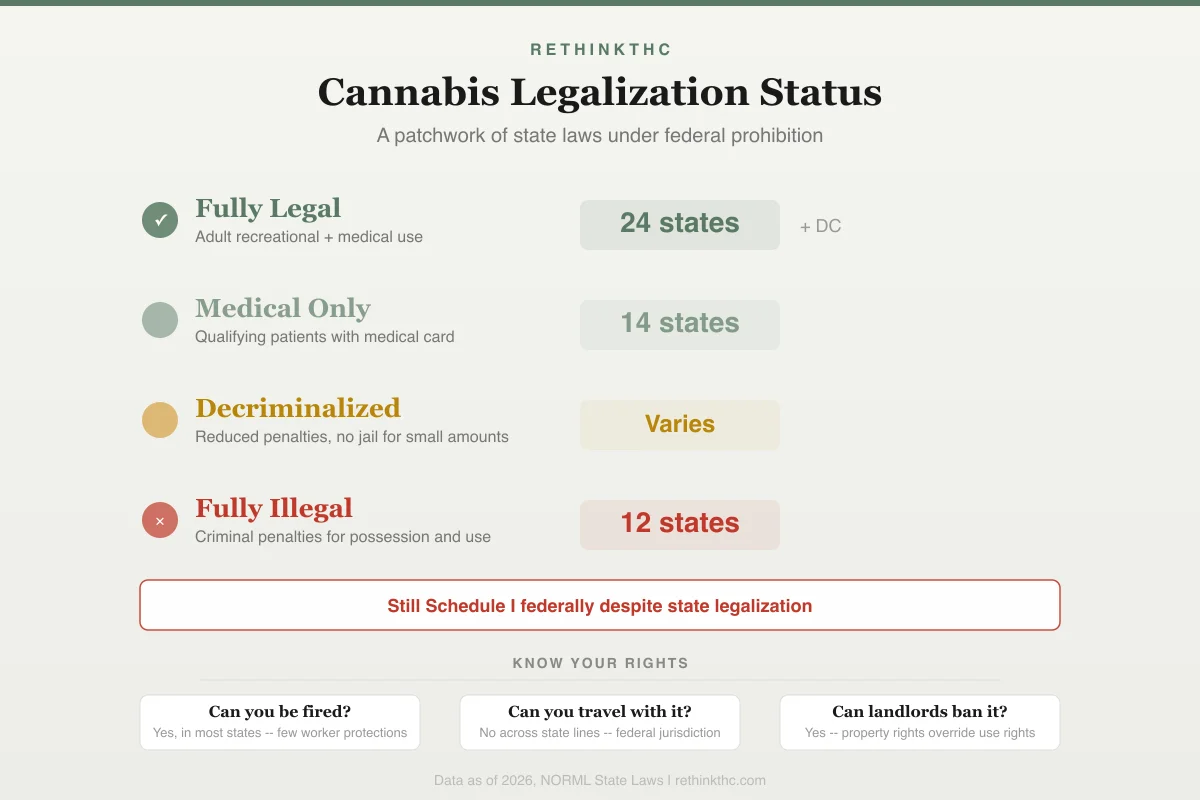
Cannabis Legalization Status
A patchwork of state laws under federal prohibition
Still Schedule I federally despite state legalization
Know Your Rights
Can you be fired?
Yes, in most states -- few worker protections exist
Can you travel with it?
No across state lines -- federal jurisdiction applies
Can landlords ban it?
Yes -- property rights override use rights
Data as of 2026, NORML State Laws
View as image ↗This classification has been in place since 1970. Despite decades of research, the passage of state legalization laws across the country, and the FDA approval of Epidiolex (a plant-derived CBD medication) in 2018, cannabis remains Schedule I at the federal level.
In 2022, the Biden administration directed the Department of Health and Human Services to review cannabis scheduling. HHS recommended reclassification to Schedule III. The DEA initiated a rulemaking process, and in 2024 a proposed rule to move cannabis to Schedule III was published. However, as of early 2026, the final rule has not been implemented. Cannabis remains Schedule I under federal law.
This matters because federal law is supreme. The Supremacy Clause of the Constitution means that when state and federal law conflict, federal law technically prevails. The reason state-legal cannabis markets exist at all is not because the conflict was resolved. It is because the federal government has largely chosen not to enforce federal cannabis law in states that have their own regulatory systems. That enforcement discretion can change with any new administration, any new attorney general, or any shift in political priorities. The Cole Memorandum (2013) deprioritized federal enforcement in legal states. It was rescinded in 2018 by then-Attorney General Jeff Sessions. Subsequent administrations have generally maintained a hands-off approach, but none have codified that approach into binding law.
If you operate within a legal state market, you are relying on a policy of nonenforcement, not on legal protection.
The State Legalization Map in 2026
As of early 2026, 24 states plus the District of Columbia have legalized recreational cannabis for adults 21 and older. An additional 14 states have comprehensive medical cannabis programs. The remaining states have either limited CBD-only programs or no legal cannabis access at all.
The details matter enormously. "Legal" does not mean the same thing in every state. Possession limits range from one ounce to two and a half ounces, and understanding how much weed you can legally possess in your state is essential. Home cultivation is permitted in some states and prohibited in others, and the rules around how much weed you can legally grow at home vary just as widely. Public consumption is banned almost everywhere, even in states with full legalization. Some states allow social consumption lounges; most do not.
The speed of rollout also varies. Some states that passed legalization ballot measures years ago still have not opened retail dispensaries due to regulatory delays, licensing disputes, or local opt-out provisions. Legalization on paper does not always mean access in practice.
If you live in a legal state, the most important thing you can do is learn the specific rules for your state, not cannabis law in general. Possession limits, where you can consume, whether you can grow at home, and what happens if you violate those rules differ significantly across jurisdictions. This guide covers the federal and cross-state issues that are common to everyone.
Employment and Drug Testing
This is where the gap between "legal" and "protected" becomes most painful for most people. In the majority of states, your employer can still test you for cannabis, and they can still fire you or refuse to hire you based on a positive test, even if you used cannabis legally, off-duty, in your own home. For a detailed look at the science, legal landscape, and practical strategies for navigating this, see using cannabis at work: risks, rights, and what the science says.
The reason is straightforward. Employment drug testing policies are generally governed by state employment law, not by the legalization statute itself. Many legalization laws explicitly include provisions stating that nothing in the law requires employers to accommodate cannabis use. Federal contractors and employees in safety-sensitive positions (transportation, healthcare, law enforcement) are subject to federal drug-free workplace requirements regardless of state law.
However, a growing number of states have begun carving out protections. California, New York, Washington, New Jersey, and several others have passed laws restricting employer use of pre-employment cannabis drug tests or prohibiting adverse employment action based on off-duty cannabis use. These protections are relatively new, and court interpretations are still developing.
The science of drug testing is relevant here. Standard urine tests detect THC-COOH, a metabolite that can remain in your system for days to weeks after last use. A positive test does not indicate current impairment. It indicates past use. For a detailed breakdown of how long THC metabolites remain detectable by test type, see how long THC stays in your system. This distinction between detecting past use and proving current impairment is at the center of the legal and scientific debate over workplace cannabis testing.
Some states are beginning to mandate that employment decisions be based on impairment-based testing rather than metabolite detection. This trend is likely to accelerate, but the technology for reliable, field-deployable THC impairment testing is still developing.
Federal and Safety-Sensitive Employment
If you work for the federal government, hold a security clearance, work in transportation regulated by the Department of Transportation (DOT), or serve in the military, cannabis use is prohibited regardless of state law. The DOT's drug testing program covers truck drivers, airline pilots, railroad workers, transit operators, pipeline workers, and commercial vessel operators. A positive cannabis test in any DOT-regulated position can end your career. Military personnel are subject to the Uniform Code of Military Justice, which prohibits cannabis use regardless of duty status or location. For a comprehensive look at how cannabis affects military careers, testing protocols, and discharge consequences, we cover the specifics in a dedicated guide.
Cannabis DUI and Driving Laws
Every state that has legalized cannabis has also established laws against driving under the influence of cannabis. The challenge is measurement.
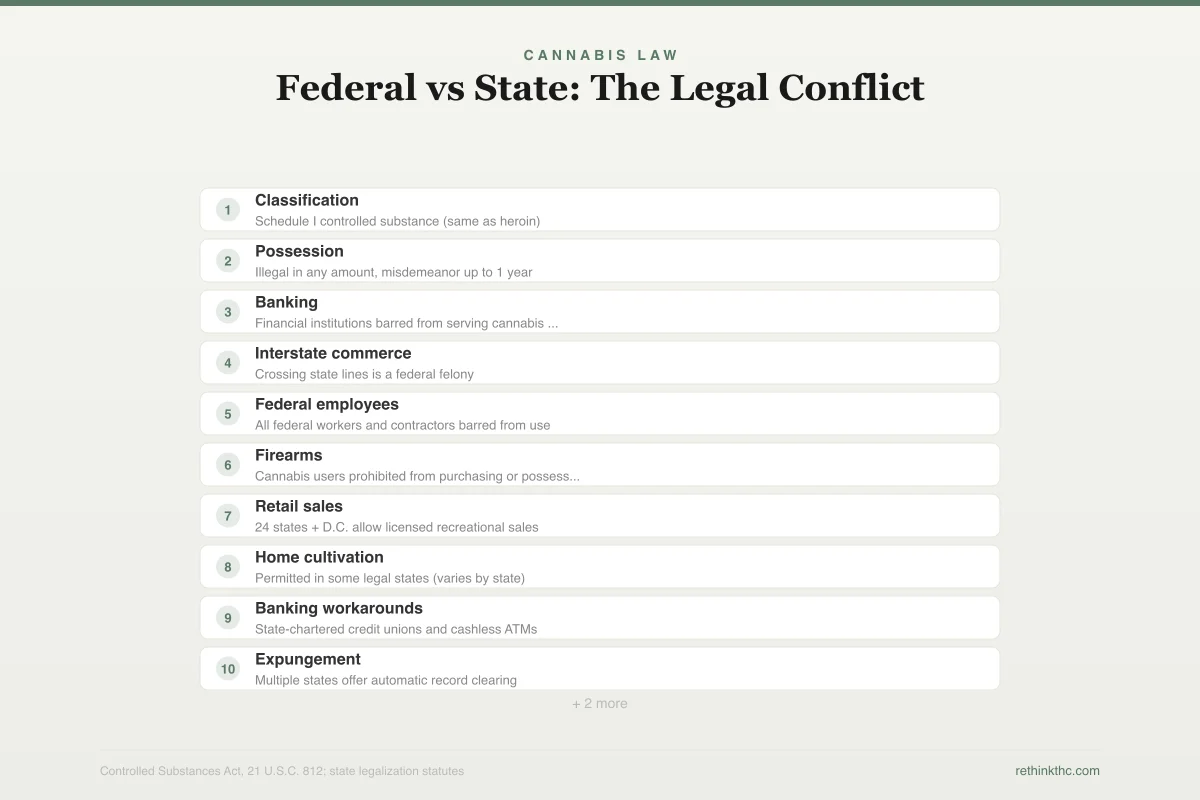
Cannabis Law
Federal vs State: The Legal Conflict
Federal Law
Controlled Substances Act
Classification
Schedule I controlled substance (same as heroin)
Possession
Illegal in any amount, misdemeanor up to 1 year
Banking
Financial institutions barred from serving cannabis businesses
Interstate commerce
Crossing state lines is a federal felony
Federal employees
All federal workers and contractors barred from use
Firearms
Cannabis users prohibited from purchasing or possessing guns
State Law (Legal States)
24 states + D.C. recreational
Retail sales
24 states + D.C. allow licensed recreational sales
Home cultivation
Permitted in some legal states (varies by state)
Banking workarounds
State-chartered credit unions and cashless ATMs
Expungement
Multiple states offer automatic record clearing
Employment protections
Growing number of states protect off-duty use
Medical programs
38 states + D.C. have comprehensive medical access
Banking
SAFE Banking Act repeatedly stalled in Senate
Employment
Federal employers enforce zero-tolerance despite state law
Firearms
ATF denies sales to known cannabis users (18 U.S.C. 922(g)(3))
Rescheduling status: DEA proposed reclassification from Schedule I to Schedule III (2024). As of early 2026, the final rule has not been implemented. Schedule III would ease research restrictions and eliminate 280E tax burdens but would not legalize cannabis.
Controlled Substances Act, 21 U.S.C. 812; state legalization statutes
 View as image ↗
Alcohol has a clear, well-validated impairment threshold: 0.08% blood alcohol concentration. Cannabis has no equivalent. THC blood levels do not correlate reliably with impairment. A daily cannabis user might have measurable THC in their blood while completely sober, while an infrequent user might be significantly impaired with a lower blood concentration. The pharmacokinetics are fundamentally different from alcohol.
For a full breakdown of how these laws work in practice, including per se limits, implied consent, and what happens if you are charged, see our guide to cannabis DUI laws, impairment testing, and penalties. Despite this scientific reality, several states have implemented per se THC limits for driving. In Colorado and Washington, the legal limit is 5 nanograms of THC per milliliter of blood. In other states, any detectable amount of THC constitutes a per se violation. In effect-based states, prosecutors must demonstrate actual impairment, which typically relies on field sobriety tests, drug recognition expert evaluations, and observed driving behavior.
The practical advice is simple: do not drive while impaired by cannabis. The legal advice is more nuanced. If you use cannabis regularly and legally, understand that you may test positive for THC in a blood draw even if you have not used recently and are not impaired. A per se state can charge you based on that result alone. If you are pulled over with weed in your car, understanding your rights is critical. If officers suspect cannabis impairment, you generally have the right to decline field sobriety tests (though refusal may carry administrative penalties like license suspension, depending on implied consent laws in your state).
The science of cannabis impairment testing is an active area of research. Several companies are developing breath-based THC detection devices that measure recent use (within the last few hours) rather than accumulated metabolites. As of 2026, none of these devices have been widely deployed or legally validated to the degree that alcohol breathalyzers have been.
Housing and Renting
If you rent your home, your landlord can generally prohibit cannabis use on the property. This is true even in states with full recreational legalization. Landlords retain the right to set smoking policies, and most legalization statutes do not override landlord restrictions. Lease clauses prohibiting cannabis are enforceable. For a detailed look at whether your landlord can evict you for using weed, including lease language, state-by-state protections, and practical strategies, see our dedicated renter's guide.
Federally subsidized housing adds another layer. Public housing authorities receive federal funding, which means they are required to comply with federal drug-free housing policies. Cannabis use, even medical use, can be grounds for eviction from federally subsidized housing. The Department of Housing and Urban Development (HUD) has confirmed this position repeatedly: federal law controls, and federal law still classifies cannabis as illegal.
If you own your home, you generally have more latitude. You can typically use cannabis in your private residence in a legal state, subject to local ordinances regarding smoking and consumption. However, homeowners associations (HOAs) can impose their own restrictions, and smoking of any kind (including cannabis) may be restricted by condominium bylaws.
Traveling With Cannabis
Flying
TSA operates under federal jurisdiction. Cannabis is a federally controlled substance. Bringing cannabis through a TSA checkpoint, even on a flight between two legal states, is technically a federal offense. Our guide to flying with weed and TSA rules covers what actually happens at security, how enforcement varies by airport, and what you need to know before you pack. TSA's stated policy is that their officers do not specifically search for cannabis, but if they discover it during routine screening, they are required to refer it to law enforcement.
In practice, outcomes vary. Some airports in legal states (notably LAX) have local policies indicating that airport police will not cite passengers for possessing amounts legal under state law. Other airports will confiscate and may refer for prosecution. The safest legal advice is that flying with THC products is a federal offense, and enforcement is unpredictable.
CBD products derived from hemp (containing less than 0.3% THC) are federally legal under the 2018 Farm Bill and are generally permitted through TSA checkpoints. However, TSA officers cannot test products on the spot to verify THC content, which can create complications.
Crossing State Lines
Transporting cannabis across state lines is a federal offense under the Controlled Substances Act, even if cannabis is legal in both states. The specifics of why crossing state lines with weed can turn a legal product into a felony are worth understanding before any road trip. This applies whether you are driving, taking a bus, or shipping cannabis by mail (USPS is a federal agency; sending cannabis through the mail is a federal crime). There are no exceptions for personal-use quantities.
Medical Cannabis Card Protections
Medical cannabis programs are now available in 38 states plus D.C. Medical cardholders generally receive additional protections beyond what recreational users have. These can include: higher possession limits, access to higher-potency products, tax exemptions, workplace protections in some states, and affirmative defenses against certain criminal charges. If you are weighing whether to get or renew a card, our analysis of whether a medical card is worth it in 2026 breaks down the benefits, costs, and trade-offs.
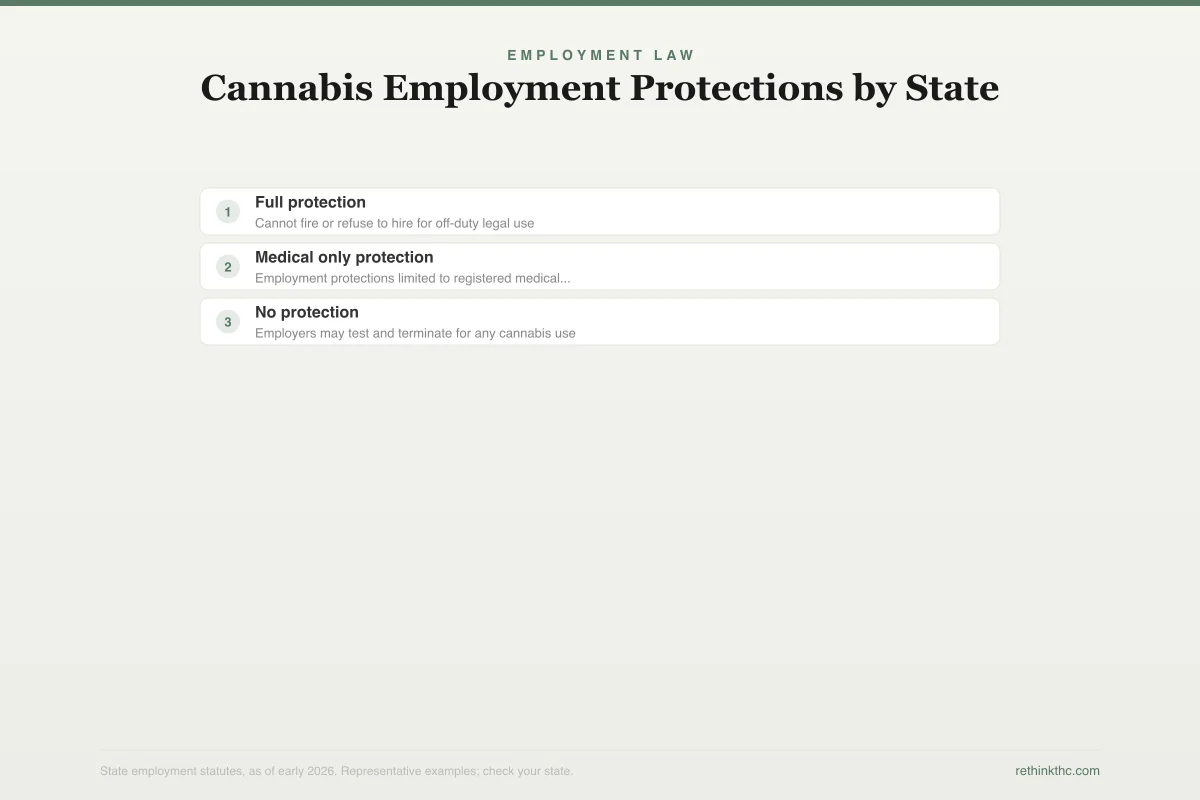
Employment Law
Cannabis Employment Protections by State
Full protection
Cannot fire or refuse to hire for off-duty legal use
Safety-sensitive & federal positions still excluded
Medical only protection
Employment protections limited to registered medical patients
Recreational users not protected
No protection
Employers may test and terminate for any cannabis use
Includes states with no legal cannabis
Always excluded: Federal employees, DOT-regulated positions (trucking, aviation, rail), military, security clearance holders, and safety-sensitive roles are subject to federal drug-free workplace requirements regardless of state protections.
State employment statutes, as of early 2026. Representative examples; check your state.
 View as image ↗
However, the medical card itself creates a documented record of cannabis use that can have consequences in other areas of law. This leads directly to two of the most significant legal conflicts affecting cannabis users.
The Gun Ownership Conflict
Under 18 U.S.C. 922(g)(3), it is a federal crime for any person who is "an unlawful user of or addicted to any controlled substance" to possess a firearm or ammunition. Because cannabis is a Schedule I controlled substance under federal law, any cannabis user is an "unlawful user" for purposes of this statute, regardless of state law.
Safety
CriticalCannabis + firearms = federal felony risk
Concern
Under federal law, any cannabis user is banned from possessing firearms or ammunition. The ATF form you fill out to buy a gun asks directly about marijuana use. Answering 'no' as a cannabis user is a federal felony. Answering 'yes' blocks the purchase.
What the research says
Courts are split on whether this survives Second Amendment scrutiny after the Supreme Court's 2022 Bruen decision. As of 2026, the prohibition is still enforceable. A medical cannabis card creates a government record that puts you on both sides of this conflict.
Particularly relevant for: Any cannabis user who owns or wants to buy firearms
What to do
If you use cannabis and own guns, understand that you are technically in violation of 18 U.S.C. 922(g)(3). Consult a firearms attorney about your specific situation.
18 U.S.C. § 922(g)(3); ATF Form 4473
ATF Form 4473, which every buyer fills out when purchasing a firearm from a licensed dealer, asks directly: "Are you an unlawful user of, or addicted to, marijuana or any depressant, stimulant, narcotic drug, or any other controlled substance?" Answering "no" as a cannabis user is a federal felony (making a false statement on a federal firearms form). Answering "yes" disqualifies you from the purchase.
For a complete breakdown of this federal conflict and its practical implications, see cannabis and gun ownership: the federal conflict explained. This conflict has been challenged in court multiple times. In 2023, the Eighth Circuit addressed the issue, and courts have continued to grapple with it in the wake of the Supreme Court's 2022 decision in New York State Rifle & Pistol Association v. Bruen, which established a new framework for evaluating firearms regulations under the Second Amendment. Lower courts have reached conflicting conclusions on whether the cannabis prohibition survives Bruen's historical test. As of early 2026, the issue has not been definitively resolved by the Supreme Court.
The practical reality: if you hold a medical cannabis card, you have created a government record that you use a federally controlled substance. If you also own firearms or attempt to purchase them, you are on both sides of a federal legal conflict. This is not hypothetical. ATF has issued guidance directing federal firearms licensees to deny sales to known medical cannabis cardholders.
Immigration Risks
For non-citizens, the consequences of cannabis involvement are potentially severe and carry no ambiguity. Federal immigration law controls, and federal law does not recognize state legalization.
Safety
CriticalNon-citizens face permanent, irreversible consequences
Concern
Any cannabis involvement — using, admitting to use, working in the industry, or even investing in a cannabis business — can result in visa denial, deportation, or a lifetime ban from entering the United States. You don't need a criminal conviction. Just admitting use during an immigration interview is enough.
What the research says
There is no workaround. Federal immigration law does not recognize state legalization. Canadian citizens have been permanently banned from the U.S. for disclosing legal cannabis use in Canada.
Particularly relevant for: Anyone who is not a U.S. citizen: visa holders, green card holders, permanent residents, DACA recipients, asylum seekers
What to do
If you are not a U.S. citizen, consult an immigration attorney before any cannabis-related activity. Do not admit to cannabis use at the border or in any immigration proceeding without legal counsel present.
8 U.S.C. § 1182(a)(2)(A)(i)(II) — controlled substance inadmissibility
Cannabis-related conduct can result in: denial of a visa application, denial of admission at the border, denial of naturalization (citizenship), deportation (removal), and permanent inadmissibility (a lifetime bar from entering the United States).
You do not need to be convicted of a crime for these consequences to apply. Admitting to cannabis use during an immigration interview, working in the cannabis industry, or even investing in cannabis businesses can trigger inadmissibility findings. Canadian citizens who disclosed past cannabis use to U.S. Customs and Border Protection have been banned from entering the United States, even though cannabis is fully legal in Canada.
If you are not a U.S. citizen and you use cannabis, work in the cannabis industry, or are considering either, consult an immigration attorney before doing anything else. This is one of the few areas of cannabis law where the consequences are both predictable and irreversible. Our guide on how cannabis affects your immigration status and green card covers the specific scenarios, case law, and practical steps in detail.
Professional Licenses
Many professional licensing boards maintain drug-related conduct as grounds for discipline. Physicians, nurses, pharmacists, attorneys, commercial drivers, pilots, teachers, and other licensed professionals may face licensing consequences for cannabis use, even in legal states.
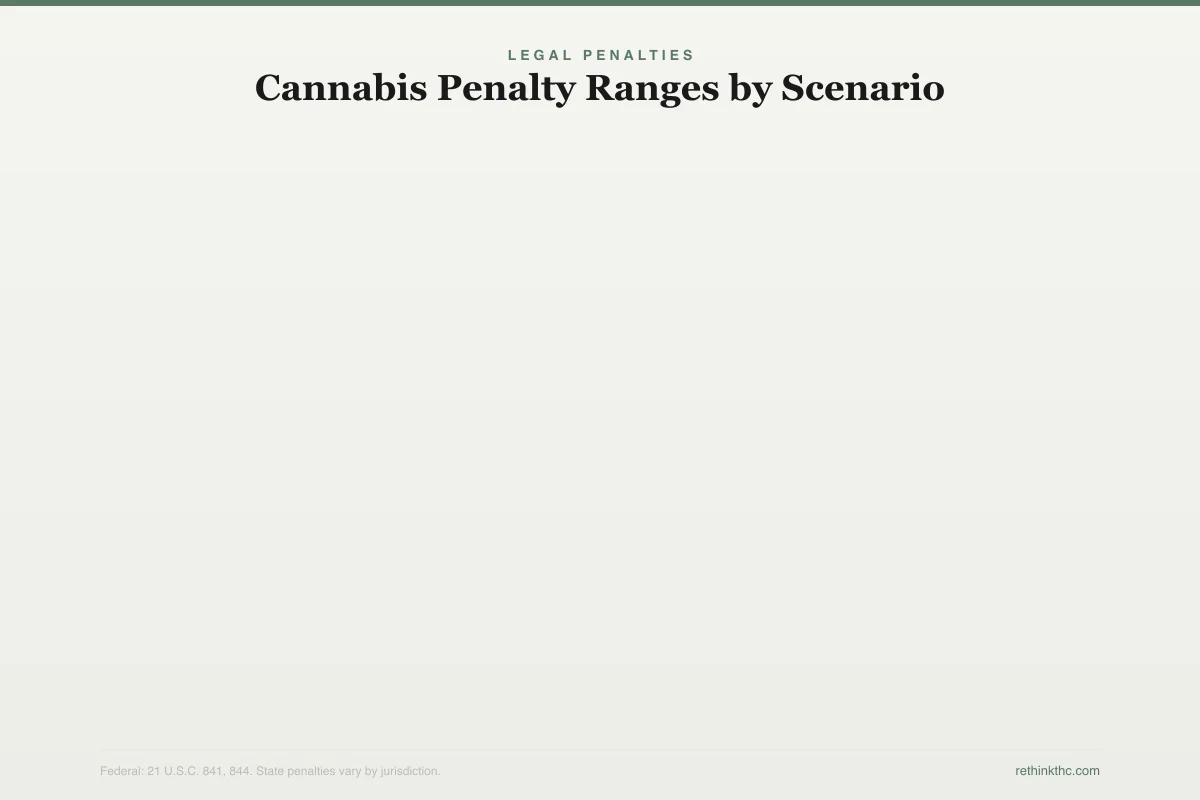
Legal Penalties
Cannabis Penalty Ranges by Scenario
Possession (small amount, legal state)
No penaltyWithin state possession limits
Possession (illegal state)
MisdemeanorVaries widely by state; some have decriminalized
Federal possession (first offense)
Misdemeanor21 U.S.C. 844(a)
Distribution (legal state, unlicensed)
FelonySelling without a state license
Federal distribution
FelonyMandatory minimums may apply
Across state lines (any amount)
Federal felonyEven between two legal states
Federal: 21 U.S.C. 841, 844. State penalties vary by jurisdiction.
 View as image ↗
The specifics depend on the licensing board, the state, and the profession. Some state medical boards have modernized their policies to distinguish between legal off-duty use and substance use disorder. Others have not. If you hold a professional license and use cannabis, check your specific licensing board's current policies. Do not assume that state legalization automatically protects your license. For a detailed look at how specific professions are affected, see cannabis and professional licenses for nurses, lawyers, and other licensed professionals.
What Changed in 2025 and 2026
The cannabis legal landscape continued to shift through 2025 and into early 2026. Several developments are worth noting.
Rescheduling remains pending. The DEA's proposed rule to reclassify cannabis from Schedule I to Schedule III remains in the rulemaking process. If completed, rescheduling to Schedule III would not legalize cannabis, but it would have significant implications. It could ease research restrictions, eliminate the IRS Section 280E tax burden that prevents cannabis businesses from deducting standard business expenses, and change the legal analysis for firearms and employment cases. However, Schedule III substances (like anabolic steroids and ketamine) are still controlled and still subject to federal regulations.
More states enacted employment protections. The trend of states passing laws restricting employer cannabis drug testing continued. Several states enacted or expanded laws prohibiting adverse employment action based on off-duty legal cannabis use, though carve-outs for safety-sensitive positions remain standard.
Banking remains difficult. Cannabis businesses still lack reliable access to banking services because financial institutions fear federal money laundering charges. The SAFE Banking Act, which would protect banks that serve state-legal cannabis businesses, has passed the U.S. House multiple times but has repeatedly stalled in the Senate. Cannabis remains a predominantly cash industry in many states, creating safety and transparency concerns.
State-level expungement programs expanded. Multiple states continued implementing automatic or streamlined expungement programs for prior cannabis convictions. These programs are a recognition that the consequences of previous prohibition continue to affect millions of Americans, disproportionately in communities of color, even as the same conduct is now legal and commercially profitable.
For a data-driven look at how legalization has affected public health outcomes across states that legalized early, see cannabis legalization effects on health data.
Practical Takeaways
Cannabis law is a patchwork. The safest approach is to understand the specific rules that apply to your specific situation: your state, your employment, your immigration status, your professional licenses, your housing situation.
A few principles apply broadly:
State legalization does not override federal law. It creates a space where the federal government has chosen not to enforce. That choice can change.
A positive drug test proves past use, not current impairment. The legal system is slowly catching up to the science, but it is not there yet in most jurisdictions.
Documentation creates consequences. A medical card, a dispensary receipt, a social media post about cannabis use: these can all become relevant in employment disputes, child custody cases, immigration proceedings, firearms cases, and professional licensing actions.
The legal landscape is moving toward broader access and fewer penalties. But the movement is uneven, incomplete, and subject to reversal. The most important thing you can do is understand the specific rules that apply to you right now, not the rules you think should apply or the rules you expect to apply in the future.
This article will be updated as federal scheduling decisions, court rulings, and state law changes warrant. Last reviewed March 2026.
The Bottom Line
Comprehensive pillar covering cannabis legal landscape as of early 2026. Federal-state conflict: cannabis remains Schedule I (same as heroin/LSD) despite 24 states + D.C. legalizing recreational use. State markets exist through federal nonenforcement discretion (Cole Memo rescinded 2018, no binding replacement). DEA Schedule III reclassification proposed but pending. Employment: most states still allow drug testing/termination for legal off-duty use; growing exceptions (CA, NY, WA, NJ). Federal/DOT/military employees cannot use regardless of state law. 49 CFR Part 40: 50/15 ng/mL cutoffs. DUI: no validated THC impairment threshold (unlike 0.08% BAC for alcohol); per se limits in some states (5 ng/mL CO/WA); breath-based THC detection devices in development. Housing: landlords can prohibit use; federally subsidized housing = federal rules (eviction risk). Travel: flying with THC = federal offense (TSA jurisdiction); crossing state lines = federal offense regardless of legality in both states. Firearms: 18 USC 922(g)(3) prohibits cannabis users from possessing firearms; ATF Form 4473 direct conflict; Bruen analysis ongoing in courts. Immigration: cannabis involvement can cause visa denial, deportation, permanent inadmissibility for non-citizens (no conviction required). Medical cards: higher possession limits but create documented federal drug use record. Professional licenses: many boards maintain drug-related discipline regardless of state legality. 2025-2026 updates: more state employment protections, SAFE Banking Act stalled, expungement programs expanding.
Is cannabis legal at the federal level in 2026?
No. Cannabis remains a Schedule I controlled substance under the federal Controlled Substances Act as of early 2026. A proposed rule to reclassify cannabis to Schedule III has been initiated by the DEA but has not been finalized. State-legal cannabis markets exist because the federal government has chosen not to enforce federal law in states with their own regulatory systems, but this is an enforcement policy, not a legal protection.
Can I be fired for using cannabis legally on my own time?
In most states, yes. The majority of states still allow employers to test for cannabis and take adverse action based on a positive result, even if the use was legal, off-duty, and occurred in your own home. A growing number of states including California, New York, and New Jersey have enacted laws restricting employer cannabis testing or prohibiting termination for legal off-duty use, but these protections are not universal and typically exclude safety-sensitive positions.
Can I fly with cannabis between two legal states?
Technically, no. TSA operates under federal jurisdiction, and bringing cannabis through a TSA checkpoint is a federal offense regardless of state legality. In practice, TSA does not specifically search for cannabis, but if discovered during routine screening, it must be referred to law enforcement. Outcomes vary by airport. Hemp-derived CBD products containing less than 0.3% THC are federally legal and generally permitted.
Does a medical marijuana card affect my right to own guns?
Yes. Under 18 U.S.C. 922(g)(3), any user of a federally controlled substance is prohibited from possessing firearms. A medical cannabis card creates a government record of controlled substance use. ATF Form 4473 asks directly about marijuana use, and answering falsely is a federal felony. Courts have reached conflicting conclusions on whether this prohibition survives Second Amendment scrutiny after the Supreme Court's Bruen decision, but the law remains enforceable as of 2026.
Can cannabis use affect my immigration status?
Yes, and the consequences can be severe and permanent. Federal immigration law does not recognize state legalization. Any cannabis involvement, including use, admission of use during an immigration interview, employment in the cannabis industry, or investment in cannabis businesses, can result in visa denial, deportation, or permanent inadmissibility. Non-citizens should consult an immigration attorney before any cannabis-related activity.
What would rescheduling cannabis to Schedule III actually change?
Rescheduling to Schedule III would not legalize cannabis. It would remain a controlled substance requiring DEA registration for manufacturers and distributors. However, it would ease federal research restrictions significantly, eliminate the IRS Section 280E tax provision that prevents cannabis businesses from deducting standard business expenses, and potentially change the legal analysis in employment, firearms, and immigration cases. Schedule III substances like anabolic steroids and ketamine can be prescribed by physicians, which could open pathways for medical cannabis under federal law.
Sources & References
- 1RTHC-00101·Watson, S J et al. (2000). “The Landmark 1999 Institute of Medicine Report: Medical Marijuana Has Promise but Smoking Is Not the Answer.” Archives of general psychiatry.Study breakdown →PubMed →↩
- 2RTHC-08306·Haley, Danielle F et al. (2026). “Recreational Cannabis Laws Linked to 9-11% Drop in Daily Opioid Use Among People Who Inject Drugs.” Drug and alcohol dependence.Study breakdown →PubMed →↩
- 3RTHC-08312·Hammond, Christopher J et al. (2026). “Cannabis Laws Linked to Increased Youth Suicide in Asian/Pacific Islander and Hispanic Populations.” American journal of preventive medicine.Study breakdown →PubMed →↩
- 4RTHC-08327·Hawkins, Summer Sherburne et al. (2026). “Cannabis Legalization Drives New Users Rather Than Heavier Use Among Existing Users.” American journal of preventive medicine.Study breakdown →PubMed →↩
- 5RTHC-08328·Hawkins, Summer Sherburne et al. (2026). “Edible Cannabis Use Surges 35% After Recreational Legalization.” Preventive medicine.Study breakdown →PubMed →↩
- 6RTHC-07850·Van Doren, Natalia et al. (2025). “Cannabis Legalization in California Was Linked to Changes in Alcohol Use — But the Direction Depends on Age.” Addiction (Abingdon.Study breakdown →PubMed →↩
- 7RTHC-07957·Winfield-Ward, Lauren et al. (2025). “How Cannabis Marketing Exposure Differs Across US States With Different Laws.” Drug and alcohol dependence.Study breakdown →PubMed →↩
- 8RTHC-07987·Xu, Carol et al. (2025). “Recreational Cannabis Laws Are Associated With People Sleeping About 5 Minutes Less.” AJPM focus.Study breakdown →PubMed →↩