Balanced & Benefits
31%
A 2017 JAMA study found only 31 percent of CBD products contained the amount of CBD stated on the label, making third-party lab verification the single most important step before buying.
Bonn-Miller et al., JAMA, 2017
31%
A 2017 JAMA study found only 31% of CBD products were
What 'Hemp-Derived' Actually Means
covered in detail
Full-Spectrum vs. Broad-Spectrum vs. Isolate
covered in detail
Bonn-Miller et al., JAMA, 2017
 View as image ↗
You are standing in a store or scrolling through a website, looking at a wall of CBD products, and every single one claims to be the best. Premium. Organic. Lab-tested. Pure. If you are searching for a CBD oil quality guide on how to choose the right product, it is probably because you have already realized something feels off about this market. You are right. The CBD industry is one of the least regulated consumer product markets in the country, and the gap between what is on the label and what is in the bottle is enormous.
This guide will show you exactly how to tell the difference between a legitimate CBD product and expensive flavored oil.
Key Takeaways
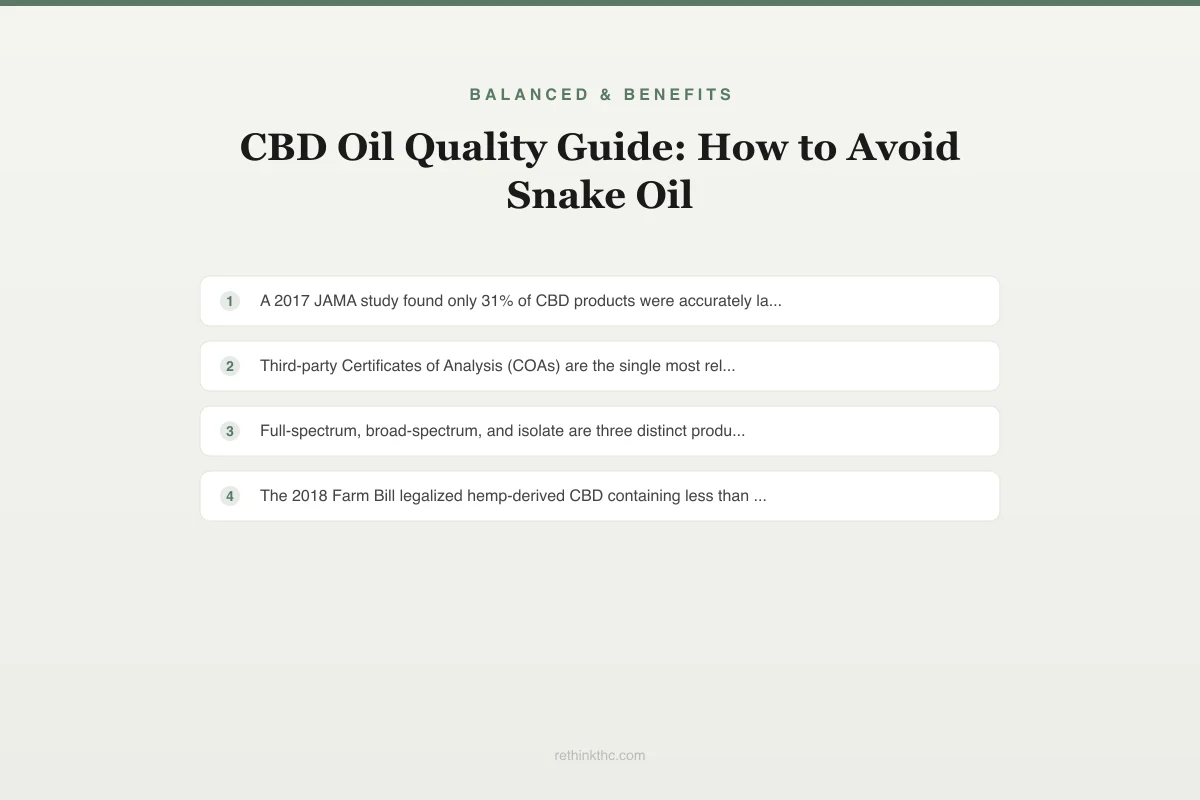
- A 2017 JAMA study found only 31% of CBD products were accurately labeled — 43% had less CBD than advertised and 21% contained THC that was not listed at all
- Third-party Certificates of Analysis (COAs) are the single most reliable way to verify what is actually inside a CBD product
- Full-spectrum, broad-spectrum, and isolate are three different product types with different cannabinoid profiles and different best uses
- The 2018 Farm Bill legalized hemp-derived CBD with less than 0.3% THC, but the FDA still does not regulate CBD products for quality or dosage accuracy
- A trustworthy CBD company will always make batch-specific lab results easy to find on their website — if you cannot find them, that is a red flag
- A 2020 follow-up study in the Journal of Clinical Pharmacology confirmed the mislabeling problem is still widespread, so this is a market-wide issue rather than a few bad actors
The CBD Market Has a Serious Accuracy Problem
CBD Product Guide: Types & Red Flags
In 2017, researchers at the University of Pennsylvania published a study in JAMA that tested 84 CBD products purchased online. The results were alarming. Only 31% of the products contained the amount of CBD stated on the label. About 43% had less CBD than advertised. And 21% contained THC that was not listed on the label at all.
This was not a fringe finding. A 2020 follow-up study published in the Journal of Clinical Pharmacology found similar patterns of mislabeling across retail CBD products. The problem is structural, not occasional. The FDA does not regulate CBD products the way it regulates pharmaceuticals or even dietary supplements. That means no one is checking whether the label matches the contents before a product hits the shelf.
If you have ever tried CBD and felt like it did nothing, this might be why. The product may have contained a fraction of the CBD it claimed, or it may have contained compounds you were not expecting. Before you decide whether CBD works for anxiety or any other purpose, you need to make sure you are actually taking real CBD in a known dose.
What "Hemp-Derived" Actually Means
You will see "hemp-derived" on almost every CBD product. Here is what that phrase means legally.
The 2018 Farm Bill created a legal distinction between hemp and marijuana. Both are cannabis plants. The only legal difference is THC content. If a cannabis plant contains less than 0.3% THC by dry weight, it is classified as hemp and is federally legal. If it contains more than 0.3% THC, it is marijuana and remains federally controlled.
"Hemp-derived CBD" means the CBD was extracted from plants that meet that 0.3% THC threshold. It does not mean the product is tested, safe, pure, or effective. It is a legal classification, not a quality standard. A company can sell hemp-derived CBD oil that is poorly extracted, contaminated with pesticides, or contains almost no actual CBD, and it is still technically "hemp-derived."
Understanding the difference between CBD and THC matters here because some hemp-derived products contain trace amounts of THC that could show up on a drug test, even though the product is legal.
Full-Spectrum vs. Broad-Spectrum vs. Isolate
These three terms describe what is in the product besides CBD. They are not marketing gimmicks. They refer to real differences in chemical composition.
Full-Spectrum CBD
Contains CBD plus all the other naturally occurring compounds in the hemp plant. That includes minor cannabinoids like CBG and CBN, terpenes (the aromatic compounds that give cannabis its smell), flavonoids, and trace amounts of THC (under 0.3%). Some researchers believe these compounds work better together than in isolation, a concept called the "entourage effect." A 2019 review in Frontiers in Plant Science found preliminary evidence supporting synergistic interactions between cannabinoids and terpenes.
Full-spectrum is the closest to the whole plant. The trade-off is that it contains a small amount of THC, which could potentially accumulate with high doses and trigger a positive drug test.
Broad-Spectrum CBD
Similar to full-spectrum but with the THC removed through additional processing. You get the other cannabinoids and terpenes without the THC. This is a middle-ground option for people who want the potential benefits of multiple plant compounds but need to avoid THC entirely.
The quality concern here is that the additional processing required to remove THC can also strip out beneficial compounds. A poorly made broad-spectrum product might end up closer to an isolate than to a true full-spectrum.
CBD Isolate
Pure CBD with everything else removed. Typically 99%+ CBD in crystalline or powder form. No other cannabinoids, no terpenes, no THC. This is the simplest product to verify because there is only one active ingredient to measure.
Isolate makes sense if you need to avoid THC completely or if you want precise dosing without other variables. The trade-off is that you lose any potential entourage effect.
None of these three types is inherently better. The right choice depends on your situation, your sensitivity to THC, and whether you are subject to drug testing. What matters most is that whatever type you choose actually contains what the label says.
How to Read a Certificate of Analysis
A Certificate of Analysis (COA) is a lab report from a third-party testing facility that details exactly what is in a specific batch of product. This is the single most important document in evaluating CBD quality. If a company does not provide COAs, do not buy their product.
Here is what to look for on a COA.
The Lab Name and Accreditation
The COA should come from an independent, ISO 17025-accredited laboratory. ISO 17025 is the international standard for testing labs. It means the lab has been audited and meets specific competency requirements. Look for the lab name, address, and accreditation number on the document. If the COA does not name the lab, treat it as worthless.
Cannabinoid Profile
This section shows the concentration of each cannabinoid detected. Look for the CBD content and compare it to what the label claims. A reasonable margin of error is plus or minus 10%. If the label says 1000mg of CBD per bottle and the COA shows 700mg, that product is significantly mislabeled.
Also check for THC content. If you bought an isolate or broad-spectrum product, THC should show as "not detected" or "ND." If you bought full-spectrum, THC should be below 0.3%.
Contaminant Testing
A complete COA tests for more than just cannabinoids. Look for results on heavy metals (lead, arsenic, mercury, cadmium), pesticides, residual solvents (chemicals left over from the extraction process), and microbial contaminants (mold, bacteria). Each of these should show "pass" or results below the acceptable limits. If the COA only tests for cannabinoids and skips contaminant panels, the company is cutting corners.
Batch Number Matching
The COA should list a specific batch number or lot number. That number should match the one printed on the product you are holding. Companies that provide only a generic COA that does not correspond to a specific production batch are not giving you meaningful quality verification.
Red Flags That Should Make You Walk Away
After reviewing hundreds of CBD product claims, certain patterns consistently signal low-quality or fraudulent products.
Medical cure claims. If a CBD product claims to cure cancer, Alzheimer's, epilepsy, or any specific disease, that is a violation of FDA regulations and a reliable indicator that the company prioritizes marketing over integrity. CBD shows promise in several areas of medical research, but no legitimate company makes cure claims.
No COA available. If you cannot find third-party lab results on the company's website, or if you have to email customer service and wait days for them, the product is not worth your money. Transparent companies make COAs easy to access.
Unrealistically low prices. Quality CBD extraction, testing, and manufacturing cost real money. If a product is dramatically cheaper than comparable options, something was skipped. That might be testing, it might be quality sourcing, or the bottle might contain far less CBD than advertised.
Proprietary blend with no milligram disclosure. Some products list a "proprietary blend" without specifying how much CBD is actually in the product. This makes it impossible to verify the dose or compare the COA to the label. You need a specific milligram amount.
Celebrity or influencer endorsements as the primary selling point. A famous person holding a bottle tells you nothing about what is inside it. Look for lab data, not social proof.
"FDA-approved" claims. As of now, the only FDA-approved CBD product is Epidiolex, a prescription medication for specific seizure disorders. No over-the-counter CBD product is FDA-approved. If a company claims otherwise, they are lying.
A Simple Checklist for Evaluating Any CBD Product
Before you buy any CBD product, run through this list.
- Can you find a batch-specific COA on the company's website without emailing anyone?
- Is the COA from an ISO 17025-accredited third-party lab (not the company's own lab)?
- Does the CBD content on the COA match the label within 10%?
- Does the COA include contaminant testing (heavy metals, pesticides, solvents, microbials)?
- Does the product clearly state the total milligrams of CBD (not just hemp extract)?
- Does the product specify whether it is full-spectrum, broad-spectrum, or isolate?
- Is the THC content consistent with the product type?
- Does the company avoid disease-cure claims?
- Is the price in a reasonable range compared to similar products?
- Can you verify the lab by searching its name independently?
If a product checks all ten boxes, it has cleared the basic quality hurdle. That does not guarantee it will be effective for your particular goal, but it does mean you are starting with a product that actually contains what it claims.
Why This Matters Beyond the Label
The accuracy problem in CBD is not just a consumer inconvenience. It is a safety issue.
If a product contains unlisted THC, someone who is subject to drug testing could fail a test they expected to pass. If a product contains less CBD than labeled, someone using it to manage something like withdrawal-related discomfort might conclude that CBD does not work when the real problem is they were underdosed.
Your endocannabinoid system is a real biological system that responds to real doses of real compounds. Putting an unknown substance in an unknown amount into that system is not a fair test of anything.
The CBD industry will eventually face tighter regulation. Multiple FDA frameworks have been proposed, and several states have implemented their own testing requirements. Until those regulations are in place, the responsibility falls on you as the consumer. The good news is that the checklist above takes about five minutes and eliminates the vast majority of questionable products.
When to Seek Professional Help
If you are considering CBD as part of managing a health condition, talk to a healthcare provider who is knowledgeable about cannabinoids. This is especially important if you take other medications, because CBD can interact with certain drugs by affecting liver enzymes called cytochrome P450.
If you are navigating a complicated relationship with cannabis or other substances and need support, the SAMHSA National Helpline is available 24/7 at 1-800-662-4357. It is free, confidential, and available in English and Spanish.
You Deserve to Know What You Are Paying For
The CBD market is not hopeless. Legitimate companies with real products and transparent testing exist. The problem is that they are mixed in with hundreds of brands selling overpriced, under-dosed, or contaminated products with no accountability.
You do not need a chemistry degree to navigate this. You need one document (the COA), one standard (ISO 17025 accreditation), and a willingness to walk away from products that cannot meet basic transparency requirements. The companies worth buying from are the ones that make quality verification easy, not the ones that make it feel like a treasure hunt.
The Bottom Line
The CBD market has a documented accuracy crisis: a 2017 JAMA study tested 84 products and found only 31% accurately labeled (43% had less CBD than stated, 21% contained unlisted THC). A 2020 Journal of Clinical Pharmacology study confirmed the problem persists. The structural cause is lack of FDA regulation — "hemp-derived" is a legal classification (under 0.3% THC per 2018 Farm Bill), not a quality standard. Three product types with distinct profiles: full-spectrum (all plant compounds including trace THC, potential entourage effect per 2019 Frontiers in Plant Science review), broad-spectrum (THC removed but other cannabinoids retained, quality varies with processing), and isolate (99%+ pure CBD, simplest to verify, no entourage effect). The Certificate of Analysis (COA) is the critical quality document: must come from an ISO 17025-accredited independent lab, must be batch-specific (lot number matching the product), must include cannabinoid profile (CBD content within 10% of label), and contaminant panels (heavy metals, pesticides, residual solvents, microbials). Red flags: medical cure claims, no COA available, unrealistically low prices, proprietary blends without milligram disclosure, celebrity endorsements as primary selling point, and false "FDA-approved" claims (only Epidiolex is FDA-approved). Quality verification checklist covers 10 criteria any consumer can assess in five minutes. Safety implications: unlisted THC can cause failed drug tests, underdosing can lead to false conclusions about CBD efficacy.
How can I tell if a CBD oil is good quality?
The most reliable indicator of quality is a batch-specific Certificate of Analysis (COA) from an ISO 17025-accredited third-party lab. The COA should show cannabinoid content that matches the label within 10%, plus passing results for contaminant tests including heavy metals, pesticides, residual solvents, and microbial screening. If a company does not provide easily accessible COAs, consider that a disqualifying red flag.
What is the difference between full-spectrum and broad-spectrum CBD oil?
Full-spectrum CBD contains all naturally occurring compounds from the hemp plant, including minor cannabinoids, terpenes, and trace amounts of THC (under 0.3%). Broad-spectrum CBD goes through additional processing to remove the THC while keeping the other compounds. If you need to avoid THC entirely due to drug testing or personal preference, broad-spectrum or isolate products are the safer choice, but verify the COA shows THC as "not detected."
Is it normal for CBD products to be mislabeled?
Unfortunately, yes. A landmark 2017 study published in JAMA tested 84 CBD products and found that only 31% were accurately labeled. About 43% contained less CBD than stated, 26% contained more, and 21% contained THC that was not listed on the label. This is a market-wide problem driven by the lack of FDA regulation for CBD products.
Can CBD oil show up on a drug test?
It depends on the product type. Full-spectrum CBD products contain trace amounts of THC (up to 0.3%), which could theoretically accumulate with high or frequent dosing and trigger a positive drug test. Products labeled as broad-spectrum or isolate should contain no THC, but mislabeling is common. If drug testing is a concern, choose products with COAs that show THC as "not detected" and verify with batch-specific lab results.
What does hemp-derived CBD mean?
"Hemp-derived" is a legal classification, not a quality indicator. Under the 2018 Farm Bill, cannabis plants containing less than 0.3% THC by dry weight are classified as hemp, and CBD extracted from these plants is federally legal. However, "hemp-derived" says nothing about the purity, potency, or safety of the final product. A hemp-derived CBD oil can still be poorly extracted, contaminated, or mislabeled.
How much should I expect to pay for quality CBD oil?
Quality CBD oil from reputable companies typically costs between $0.05 and $0.15 per milligram of CBD. A 30ml bottle containing 1000mg of CBD would reasonably cost between $50 and $150. Products significantly below this range should raise questions about sourcing, extraction quality, or whether the labeled CBD content is accurate. Products significantly above this range may be overpriced without corresponding quality improvements. The price should reflect third-party testing, quality extraction methods (CO2 extraction is considered the gold standard), and transparent manufacturing practices. Compare the cost per milligram rather than the bottle price, since products vary widely in concentration. The most expensive product is not necessarily the best, but the cheapest product almost always cuts corners somewhere.
Sources & References
- 1RTHC-08512·Murri, Martino Belvederi et al. (2026). “Large meta-analysis finds regular cannabis use raises both pro-inflammatory and anti-inflammatory markers, not just one or the other.” Brain.Study breakdown →PubMed →↩
- 2RTHC-08708·Weidberg, Sara et al. (2026). “Nearly 29% of North Americans have tried CBD, about double the rate in Europe.” Addiction (Abingdon.Study breakdown →PubMed →↩
- 3RTHC-06153·Candeloro, Bruno Moreira et al. (2025). “Meta-Analysis Found CBD and THC Had Trivial Effects on Blood Inflammation Markers.” International journal of molecular sciences.Study breakdown →PubMed →↩
- 4RTHC-06220·Chou, Roger et al. (2025). “Cannabis products with THC showed small pain improvements with significant side effects, while CBD alone did not help.” Pain and therapy.Study breakdown →PubMed →↩
- 5RTHC-05271·Ding, Cheng et al. (2024). “Meta-analysis found cannabis use disorder linked to more complications and higher costs after hip and knee replacements.” The Journal of the American Academy of Orthopaedic Surgeons.Study breakdown →PubMed →↩
- 6RTHC-03713·Bilbao, Ainhoa et al. (2022). “Major meta-analysis of 152 RCTs finds cannabinoid effectiveness varies dramatically by specific drug and condition.” BMC medicine.Study breakdown →PubMed →↩
- 7RTHC-04223·Silvinato, Antônio et al. (2022). “Meta-analysis confirmed CBD reduces seizures by 33% in treatment-resistant epilepsy.” Revista da Associacao Medica Brasileira (1992).Study breakdown →PubMed →↩
- 8RTHC-03179·Gunning, Boudewijn et al. (2021). “CBD reduced seizures in both Dravet and Lennox-Gastaut syndromes, with enhanced effects when combined with clobazam.” Acta neurologica Scandinavica.Study breakdown →PubMed →↩