Balanced Cannabis Science
4% → 80%+
THC potency tripled between 1995 and 2014 and today's concentrates top 80%, which means street cannabis with no testing for pesticides, heavy metals, or mold carries risks that did not exist a generation ago.
Biological Psychiatry, 2016
4%
THC potency tripled between 1995 and 2014 (from about 4% to
What Testing and Regulation Actually Mean
covered in detail
Potency: Known vs Unknown
covered in detail
Biological Psychiatry, 2016
 View as image ↗
If you only read one thing
The biggest difference between dispensary weed and street weed isn't the high — it's the stuff you can't see. Legal cannabis gets tested for pesticides, heavy metals, mold, and solvents before it hits the shelf. Street cannabis gets tested by nobody. You also get a label telling you exactly how strong it is. THC potency has tripled since the '90s, so smoking something with unknown strength is a real gamble. Legal isn't risk-free, but at least you know what you're putting in your body.
Whether cannabis should be legal is a political question. Whether regulated cannabis is safer than unregulated cannabis is an empirical one. This article is about the second question. It is not advocacy for legalization or an argument that legal cannabis is harmless. It is a factual comparison of what you are likely consuming when you buy from a licensed dispensary versus an unregulated source, and why that difference matters for your health.
The short version: the biggest safety difference is not the plant itself. It is the testing infrastructure (or lack of it) that sits between the product and your lungs.
Key Takeaways
- Legal cannabis must pass mandatory testing for pesticides, heavy metals, mold, and potency — street cannabis has zero quality control
- THC potency tripled between 1995 and 2014 (from about 4% to 12%), and today's concentrates often top 80%, so street products with unknown potency carry unpredictable risks
- Pesticides, heavy metals, residual solvents, and mold have all been found in unregulated cannabis products, including the delta-8 market where a 2023 review flagged widespread labeling problems
- Fentanyl-laced weed is extremely rare, but contamination in the broader street drug supply makes unregulated sources an inherently riskier bet
- Legal markets are not perfect — higher prices push some buyers to the street — but the testing they require gives you information that is simply unavailable with unregulated products
- Cannabis is a bioaccumulator, meaning the plant soaks up heavy metals from soil, so testing is the only way to catch contamination you cannot see, smell, or taste
What Testing and Regulation Actually Mean
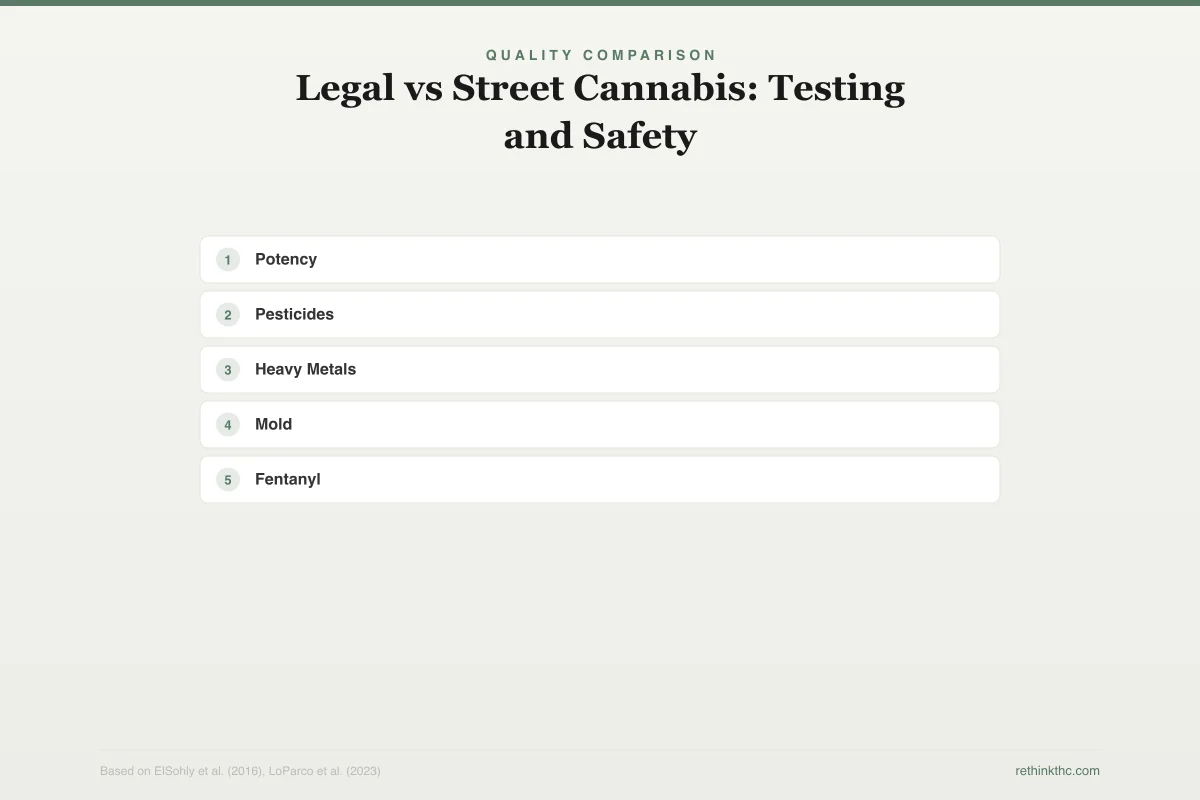
In states with legal, regulated cannabis markets, products sold in licensed dispensaries must meet specific safety standards before reaching consumers. The exact requirements vary by state, but most legal markets mandate testing for:
Quality Comparison
Legal vs Street Cannabis: Testing and Safety
The biggest safety difference is testing infrastructure, not the plant itself
Potency
Lab-tested, labeled (±15% accuracy)
TestedCompletely unknown
No testingPesticides
Tested, limits enforced, banned substances screened
TestedUntested, common contamination
UnregulatedHeavy Metals
Tested for lead, cadmium, arsenic, mercury
TestedUnknown, cannabis bioaccumulates from soil
UnregulatedMold
Tested for aspergillus, botrytis, penicillium
TestedCommon in improperly stored product
UnregulatedFentanyl
Virtually zero risk (never enters illicit supply)
SafeExtremely rare but documented in broader market
Low riskBased on ElSohly et al. (2016), LoParco et al. (2023)
 View as image ↗
- Pesticide residues (including banned substances like myclobutanil, which converts to hydrogen cyanide when heated)
- Heavy metals (lead, cadmium, arsenic, mercury)
- Microbial contaminants (mold, bacteria, yeast)
- Residual solvents (butane, propane, ethanol, used in extraction for concentrates and vape products)
- Potency (actual THC and CBD percentages)
Products that fail testing are not supposed to reach shelves. Dispensaries operate with licenses that can be revoked for compliance violations. There is a chain of custody from cultivation to sale, and state agencies conduct inspections.
Street cannabis has none of this. No testing. No labeling requirements. No quality control. No accountability if something goes wrong. Whatever the grower used on the plant, whatever the product was stored in, whatever it was cut with or contaminated by, you would have no way of knowing.
| Safety Category | Legal (Regulated) | Street (Unregulated) |
|---|---|---|
| Pesticide testing | Mandatory; banned substances screened | None; any pesticide may be used |
| Heavy metals | Tested before sale | No testing; cannabis bioaccumulates metals from soil |
| Mold and bacteria | Microbial screening required | No screening; improper storage common |
| Residual solvents | Tested in concentrates and vapes | No testing; unknown cutting agents possible |
| Potency labeling | Lab-verified THC/CBD percentages | No labeling; potency unknown |
| Product traceability | Seed-to-sale tracking | No chain of custody |
| Accountability | License revocation for violations | None |
Potency: Known vs Unknown
One of the most significant practical differences between legal and street cannabis is potency transparency.
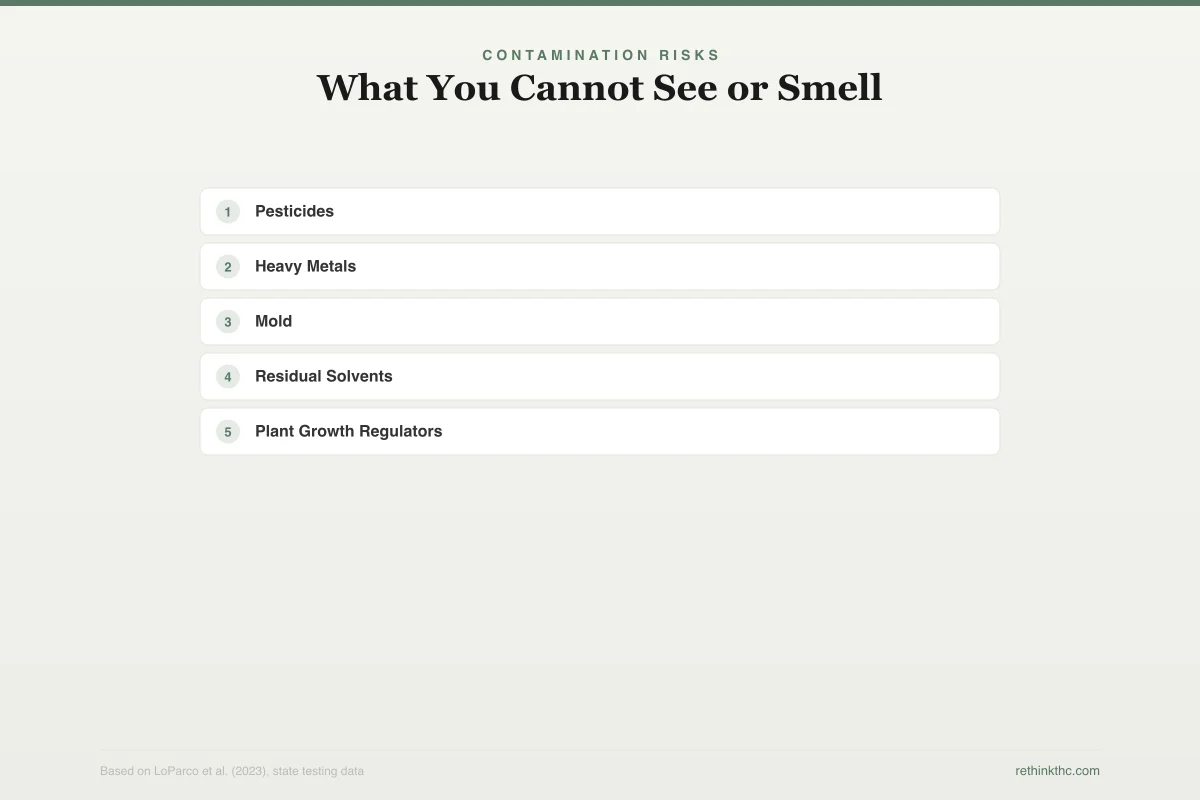
Contamination Risks
What You Cannot See or Smell
Contaminant types found in unregulated cannabis products
Pesticides
High concernMyclobutanil, bifenthrin, paclobutrazol
Myclobutanil converts to hydrogen cyanide when heated. Toxic byproducts not found in agricultural use.
Common in unregulated grows
Heavy Metals
High concernLead, cadmium, arsenic, mercury
Cannabis bioaccumulates from soil. Chronic exposure damages kidneys, nervous system, and bones.
Found in untested products (LoParco 2023)
Mold
High concernAspergillus, botrytis, penicillium
Respiratory irritation in healthy users. Life-threatening infections in immunocompromised people.
Common in improperly stored cannabis
Residual Solvents
Moderate concernButane, propane, ethanol
Found in concentrates and vape products. Can cause respiratory damage when inhaled.
Primarily in unregulated concentrates
Plant Growth Regulators
Moderate concernPaclobutrazol, daminozide
Used to increase density and yield. Possible carcinogens when combusted. Limited research.
Used by some commercial growers
You cannot identify any of these by looking at, smelling, or tasting cannabis. Laboratory testing is the only detection method.
Based on LoParco et al. (2023), state testing data
 View as image ↗
ElSohly and colleagues documented in a 2016 study in Biological Psychiatry[1] that THC potency in cannabis roughly tripled between 1995 and 2014, rising from approximately 4% to 12%. That trend has continued. Modern dispensary flower commonly tests between 20% and 30% THC, and concentrated products (dabs, vape cartridges, shatter) can exceed 80%.
ElSohly et al. (2016) · Biological Psychiatry
- Population
- 38,681 cannabis samples seized by the DEA between 1995 and 2014
- Intervention
- Chemical analysis of THC and CBD concentrations over 20 years
- Comparator
- Samples compared across time periods
- Finding
- THC tripled from about 4% to 12% over 20 years. At the same time, CBD dropped from 0.28% to under 0.15%. The THC-to-CBD ratio went from 14:1 to approximately 80:1 — meaning today's cannabis delivers far more THC with far less of the compound that may moderate its effects.
positive Robust dataset of nearly 40,000 samples with clear, consistent trend
ElSohly et al. (2016), Biological Psychiatry, 79(7), 613-619
In a legal market, those numbers are on the label. You know what you are getting. You can make informed decisions about dosing. A 15% THC flower is a meaningfully different experience from a 30% THC flower, and both are dramatically different from an 85% concentrate. For a detailed look at how concentrated products affect dependence and withdrawal differently than flower, see the dab and concentrate addiction guide.
With street cannabis, you have no potency information. What your dealer calls "strong" is a subjective assessment, not a measured value. This matters for several reasons. First, you cannot dose accurately if you do not know the potency. Second, unexpectedly high-potency cannabis is a common trigger for acute anxiety, panic attacks, and emergency room visits. Third, if you are trying to cut back or moderate your use, unknown potency makes that nearly impossible because you do not have a consistent baseline.
Contamination: What You Cannot See or Smell
Contamination is the risk category where the gap between legal and street cannabis is widest.
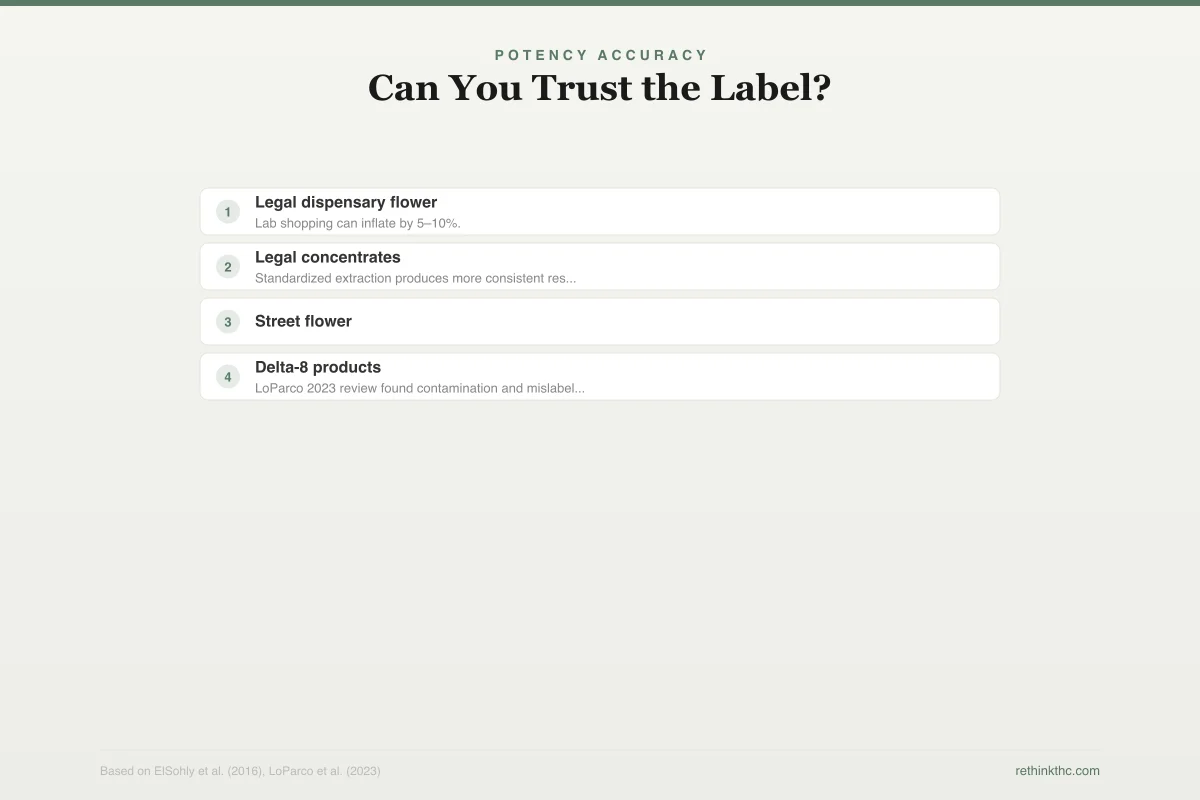
Potency Accuracy
Can You Trust the Label?
Potency labeling accuracy varies dramatically by source
Legal dispensary flower
Moderate trustLab shopping can inflate by 5–10%. "THC Olympics" drives potency marketing.
Legal concentrates
Moderate trustStandardized extraction produces more consistent results than flower.
Street flower
No data"Strong" is a subjective claim, not a measured value. No dosing possible.
Delta-8 products
Low trustLoParco 2023 review found contamination and mislabeling across unregulated market.
Why accuracy matters
Unknown potency makes dosing impossible. Unexpectedly high THC is a common trigger for panic attacks and ER visits. If trying to cut back, you need a consistent baseline — impossible without potency data.
Based on ElSohly et al. (2016), LoParco et al. (2023)
 View as image ↗
Pesticides
Cannabis plants are susceptible to pests and mold, especially in indoor growing operations. Growers in regulated markets can only use approved pesticides and must pass residue testing. Unregulated growers face no such constraints. Some pesticides commonly found on untested cannabis (such as myclobutanil, bifenthrin, and paclobutrazol) are particularly dangerous when combusted or vaporized, producing toxic byproducts that you would never encounter from the pesticide's intended agricultural use.
You cannot identify pesticide contamination by looking at or smelling cannabis. Testing is the only way to know.
Heavy Metals
Cannabis is a bioaccumulator, meaning it readily absorbs heavy metals from the soil it grows in. Lead, cadmium, arsenic, and mercury can all end up in the plant tissue. In regulated markets, harvested cannabis is tested for heavy metal content. In unregulated operations, particularly outdoor grows on contaminated land or operations using untested fertilizers, there is no mechanism to catch this contamination.
The LoParco 2023 scoping review in Addiction[2], while focused on the delta-8 THC market, documented contamination with heavy metals and residual solvents in unregulated cannabinoid products. This finding is relevant beyond delta-8 because it illustrates what happens when cannabis products reach consumers without mandatory testing: contamination goes undetected and unreported until someone gets sick.
Mold and Microbial Contamination
Improperly dried, cured, or stored cannabis can develop mold (Aspergillus, Botrytis, Penicillium) and harmful bacteria. For most healthy users, exposure to small amounts of mold may cause respiratory irritation. For immunocompromised individuals, it can cause serious, potentially life-threatening infections. Legal markets test for microbial contamination. Street markets do not.
Vape Cartridge Risks
The contamination concern is especially acute for vape cartridges purchased from unregulated sources. The 2019 EVALI outbreak (e-cigarette or vaping product use-associated lung injury) that hospitalized thousands of people was primarily traced to vitamin E acetate, a cutting agent used in illicit THC vape cartridges. Legal, tested cartridges were not implicated. For more on the specific risks of vaping cannabis products, see the weed vape pen addiction guide.
Safety
CriticalUnregulated vape cartridges carry the highest contamination risk
Concern
The 2019 EVALI outbreak hospitalized thousands and killed dozens of people. It was traced to vitamin E acetate, a cutting agent used in illicit THC vape cartridges. Cartridges from regulated sources were not implicated. Unregulated vape carts also carry risks of residual solvents, heavy metals leaching from cheap hardware, and unknown additives.
What the research says
Regulated vape cartridges undergo solvent, potency, and contaminant testing. Flower from unregulated sources, while not safe, carries a lower contamination risk profile than cartridges because it involves fewer manufacturing steps.
Particularly relevant for: Anyone using THC vape cartridges from unregulated sources
What to do
If you vape, use only cartridges from licensed dispensaries with verifiable lab testing. Avoid black-market carts entirely — they are the single highest-risk cannabis product category.
CDC EVALI investigation (2019); LoParco et al. (2023), Addiction
The Fentanyl Question
Fentanyl contamination in cannabis has received significant media attention. The concern is understandable given the severity of the fentanyl crisis in the broader drug supply. Here is what the evidence currently shows.
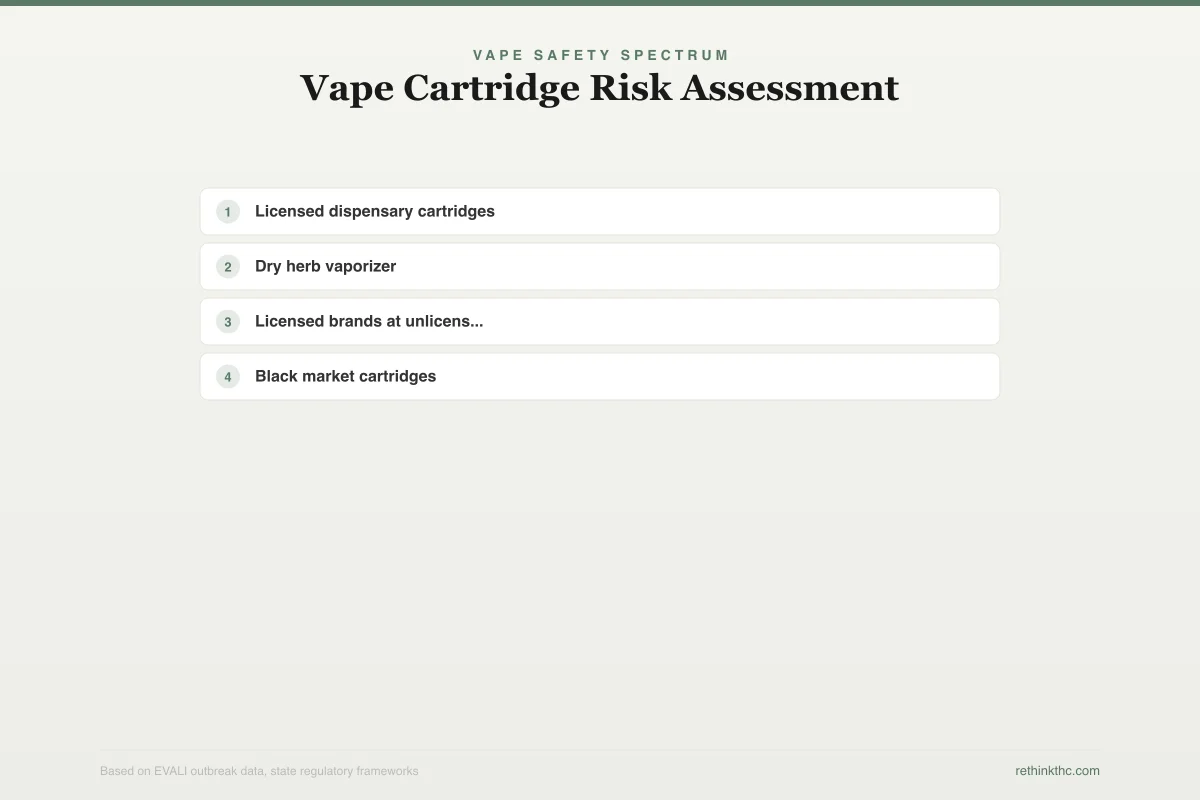
Vape Safety Spectrum
Vape Cartridge Risk Assessment
Risk varies dramatically by source — not all vape products are equal
Licensed dispensary cartridges
Lowest riskLab-tested for solvents, heavy metals, pesticides. Regulated supply chain. Not implicated in EVALI outbreak.
Dry herb vaporizer
Low–moderate riskNo additives, cutting agents, or solvents. Lower toxicant exposure than smoking. Product quality still depends on source.
Licensed brands at unlicensed shops
Moderate–high riskCounterfeit packaging is widely available. Familiar branding does not guarantee authentic product. No supply chain verification.
Black market cartridges
Highest riskEVALI outbreak traced to vitamin E acetate in illicit carts. Unknown additives, cutting agents, and heavy metals. Thousands hospitalized in 2019.
If you vape, regulated products with verifiable testing are the lower-risk option. Avoid all unregulated cartridges.
Based on EVALI outbreak data, state regulatory frameworks
 View as image ↗
Fact Check
The fentanyl-laced weed scare
The claim
“Street weed is commonly laced with fentanyl”
Media reports and social media, amplified by the broader fentanyl crisis
What research shows
OverstatedDocumented cases of fentanyl in cannabis are extremely rare. Cannabis is not a common vector for fentanyl adulteration. The economics don't favor it — fentanyl costs more per dose than cannabis. Most reported cases involve cross-contamination from shared equipment, not intentional lacing.
The risk is not zero. Any product from an unregulated supply chain carries some contamination possibility, especially as fentanyl saturates the broader illicit drug market. But the level of fear around fentanyl-laced weed is disproportionate to the actual documented evidence.
Published case reports and DEA data on cannabis contamination
Documented cases of fentanyl in cannabis products are extremely rare. Unlike cocaine, heroin, or counterfeit pills, where fentanyl contamination is a well-documented and widespread problem, cannabis is not a common vector. The economics do not favor it (fentanyl is far more expensive per dose than cannabis), and cross-contamination from shared equipment or storage spaces accounts for most of the reported cases.
That said, "extremely rare" is not "impossible." Any product obtained from an unregulated source carries some level of risk for cross-contamination, especially as the fentanyl supply has saturated the broader illicit drug market. For a detailed assessment of this risk and how to evaluate it, the laced weed and fentanyl contamination guide covers the evidence.
Legal cannabis from a licensed dispensary carries essentially zero fentanyl risk because the product never enters the illicit supply chain.
What Legalization Has Not Fixed
This article is a comparison, not a celebration of legal markets. Regulated cannabis systems have real problems that affect safety outcomes.
Price
Legal cannabis is often significantly more expensive than street cannabis, largely because of taxes, compliance costs, testing fees, and licensing expenses. In some states, legal cannabis costs two to three times what the same quantity costs on the street. This price differential pushes a meaningful percentage of consumers, including those who might prefer the regulated product, back to the unregulated market.
The harm reduction implication is straightforward: if the safer product is too expensive for many consumers, the safety benefit of regulation does not reach the people who might benefit from it most.
Testing Integrity
Not all testing labs in legal markets operate with equal rigor. There have been documented cases of labs inflating potency numbers (because higher THC percentages sell better), inconsistent testing methodologies across states, and occasional failures in the oversight of testing facilities themselves. The testing infrastructure is better than nothing, significantly better. But it is not infallible.
Access Inequality
Legal cannabis remains unavailable in many states. And in states where it is legal, the retail infrastructure is not evenly distributed. Rural areas, lower-income neighborhoods, and communities that bore the disproportionate burden of cannabis prohibition often have the fewest dispensaries. This means the safety benefits of regulation are not equally accessible.
Potency Arms Race
Legalization has, in some ways, accelerated the trend toward higher-potency products. Legal markets compete on THC percentage, and consumer demand for stronger products drives cultivators to maximize potency. ElSohly's 2016 data[1] documented potency tripling over two decades, and that trend has continued in legal markets. Higher potency products carry higher risks of dependence and adverse effects. Volkow and colleagues noted in a 2014 review in the New England Journal of Medicine that cannabis adverse health effects include a 9% lifetime dependence rate overall, rising to 17% among adolescent-onset users, along with associations with chronic bronchitis and cognitive effects.
For an evidence-based overview of whether cannabis is addictive and what drives that risk, the science is clear that potency is a factor.
Evidence Review
Where the evidence stands
Cell & Lab Studies
Chemical analysis methods for detecting contaminants well-established
Animal Studies
Toxicology of combusted pesticides (e.g., myclobutanil → hydrogen cyanide) documented
Case Reports
EVALI outbreak: thousands hospitalized from vitamin E acetate in illicit vape carts (2019)
Small Human Trials
ElSohly: 38,681 samples over 20 years; LoParco: delta-8 contamination review
Large Randomized Trial
Meta-Analysis
The evidence that unregulated cannabis carries contamination risks is strong and consistent. Potency trends are documented across nearly 40,000 samples. The EVALI outbreak provided real-world proof of what happens without testing. What's missing are large-scale studies directly comparing health outcomes between legal and street market users.
ElSohly et al. (2016); LoParco et al. (2023); CDC EVALI data (2019)
Harm Reduction: Making Safer Choices Regardless of Source
If you use cannabis from any source, some practical considerations:
If you have access to legal products, use them. The testing infrastructure is imperfect, but it is dramatically better than nothing. You get potency information, contamination screening, and product traceability that simply do not exist in the street market.
If you use street cannabis, know what you cannot know. You have no reliable way to assess potency, pesticide content, heavy metal contamination, or microbial safety. This is not a moral judgment. It is a practical limitation that affects your risk profile.
Avoid unregulated vape cartridges. The EVALI outbreak demonstrated that the contamination risk for illicit vape cartridges is substantially higher than for flower. If you vape, regulated products with verifiable testing are the lower-risk option.
Start low and go slow with any new product. This is especially important with street cannabis because you do not know the potency. But it applies to legal products too, particularly concentrates and edibles. The harm reduction guide to vaping vs smoking vs edibles covers how each consumption method carries different risk profiles regardless of source.
Monitor your use patterns. Whether your cannabis comes from a dispensary or a dealer does not change the dependence risk from chronic, heavy use. Regulated products may be cleaner, but using them daily and in increasing amounts still drives the same CB1 receptor downregulation and tolerance cycle that underlies cannabis dependence.
The Bottom Line
The difference between legal and street cannabis is not primarily about the plant. It is about information. Legal markets give you tested, labeled products with known potency and verified safety profiles. Street markets give you none of that. You are trusting someone else's word with no independent verification.
That information gap has real health consequences. Contaminated products cause real harm. Unknown potency leads to real adverse events. And the absence of any quality control means that every purchase from an unregulated source is, to some degree, a gamble.
None of this means legal cannabis is risk-free. Cannabis carries health risks regardless of where you buy it. Dependence, cognitive effects, respiratory issues from smoking, and mental health interactions are all present with legal products too. But those risks are at least manageable when you know what you are using. They become less manageable when you do not.
When to Seek Professional Help
If you are concerned about your cannabis use, regardless of source, and have found it difficult to cut back or stop on your own, professional support is available. Dependence on cannabis is a recognized clinical condition with effective treatment approaches.
If you or someone you know is struggling with substance use, SAMHSA's National Helpline is available at 1-800-662-4357. It is free, confidential, available 24/7, and provides referrals to local treatment facilities, support groups, and community-based organizations.
The Bottom Line
The biggest safety difference between legal and street cannabis is not the plant itself but the testing infrastructure. Regulated markets require mandatory testing for pesticides, heavy metals, mold, residual solvents, and potency accuracy. Street cannabis has none of this. THC potency tripled between 1995 and 2014, and modern concentrates exceed 80%, making unknown potency from unregulated sources a significant risk factor. A 2023 scoping review documented contamination with heavy metals and solvents in unregulated cannabinoid products. The 2019 EVALI outbreak, traced to vitamin E acetate in illicit vape cartridges, hospitalized thousands. Fentanyl contamination in cannabis is extremely rare but not impossible. Legal markets have their own problems (higher prices, testing integrity issues, access inequality, potency arms race), but they provide information and accountability that street markets cannot.
Is legal weed safer than street weed?
In terms of contamination and potency transparency, yes. Legal cannabis in regulated markets must pass testing for pesticides, heavy metals, mold, and solvents, and must be accurately labeled for potency. Street cannabis has no testing or quality control. However, legal cannabis still carries the same pharmacological risks (dependence, cognitive effects, respiratory effects from smoking) as any cannabis product.
Can street weed be laced with fentanyl?
Documented cases of fentanyl in cannabis are extremely rare. Unlike other drug markets where fentanyl contamination is widespread, cannabis is not a common vector. Most reported cases appear to involve cross-contamination from shared equipment rather than intentional adulteration. However, any product from an unregulated source carries some contamination risk.
Why is street weed cheaper than dispensary weed?
Legal cannabis prices include state and local taxes (often 20% to 40%), compliance and testing costs, licensing fees, and the overhead of operating a regulated retail business. Street cannabis avoids all of these costs. The price difference is significant enough that it drives some consumers away from the regulated market, which is a genuine policy problem.
How do I know if my weed is contaminated?
You cannot tell by looking at, smelling, or tasting cannabis whether it contains pesticide residues, heavy metals, or microbial contamination. Visual inspection might catch obvious mold in some cases, but most contamination is invisible. This is exactly why laboratory testing exists in regulated markets, and why its absence in the street market is a meaningful safety concern.
Does the source of cannabis affect addiction risk?
The source does not change the fundamental pharmacology. THC activates CB1 receptors regardless of whether it comes from a dispensary or the street. The dependence risk from chronic, heavy use is the same. Where source matters is in dosing accuracy: with labeled, tested products, you can control your intake more precisely, which may help with moderation. With unknown-potency products, accidental overconsumption is more likely.
Are unregulated vape cartridges riskier than unregulated flower?
Yes, significantly. Vape cartridges involve additional manufacturing steps (extraction, formulation, filling) that introduce contamination risks beyond what exists with flower. The 2019 EVALI outbreak, which hospitalized thousands and killed dozens, was traced to vitamin E acetate used as a cutting agent in illicit THC cartridges. Regulated cartridges were not implicated. Flower can contain pesticides, mold, and heavy metals, but cartridges add the risks of residual solvents, cutting agents, and heavy metals leaching from cheap hardware. If you are choosing between unregulated sources, flower carries a lower contamination risk profile than cartridges.
Sources & References
- 1RTHC-01144·ElSohly, Mahmoud A. et al. (2016). “U.S. Cannabis Potency Tripled Over Two Decades While CBD Nearly Vanished.” Biological Psychiatry.Study breakdown →PubMed →↩
- 2RTHC-04728·LoParco, Cassidy R. et al. (2023). “Delta-8 THC: The Legal-Loophole Cannabinoid That's Booming with Minimal Research.” Addiction.Study breakdown →PubMed →↩