Harm Reduction & Moderation
Double ≠ 2x High
Clinical research shows that doubling a THC dose disproportionately increases anxiety and cognitive impairment while only modestly increasing euphoria, making precise milligram dosing more important than most consumers realize.
Vandrey et al., JAMA, 2020
The Microdose Range: 1-2.5 mg THC
covered in detail
The Standard Dose Range: 5-10 mg THC
covered in detail
Dosing for Specific Situations
covered in detail
Vandrey et al., JAMA, 2020
 View as image ↗
Cannabis dosing is one of the most consequential decisions a consumer makes, and one of the least understood. Unlike alcohol, where a "standard drink" framework has been drilled into public consciousness for decades, cannabis has no widely adopted equivalent. A 5 mg edible and a deep inhale from a high-potency vape pen are both "one dose" in common parlance, but they deliver radically different pharmacological experiences. This guide translates clinical research into practical milligram ranges you can actually use.
Key Takeaways
- The right THC dose is different for everyone, but clinical research gives us useful milligram ranges as starting points for each experience level
- A microdose of 1 to 2.5 mg THC can shift your mood and focus without noticeable impairment — which makes it a practical starting point for new users
- The standard recreational dose of 5 to 10 mg THC is where most people feel clearly high, though tolerance and body composition make a big difference
- Edibles, tinctures, and inhaled cannabis all process THC differently in your body, so the same milligram dose can feel dramatically different depending on how you take it
- "Start low and go slow" isn't just a slogan — clinical trials consistently show that lower doses often work better than higher ones for pain relief and anxiety reduction
- Your genetics, liver enzyme activity, and prior cannabis experience can shift your effective dose by 2 to 5 times compared to someone else's
Why Dosing Matters More Than Most People Think
The relationship between THC dose and effect is not linear. A 2019 study published in Drug and Alcohol Dependence found that doubling a THC dose did not simply double the intensity of effects. Instead, higher doses disproportionately increased anxiety and cognitive impairment while only modestly increasing euphoria. The therapeutic window for THC, the range where benefits outweigh side effects, is narrower than most consumers realize.
Dosing Safety
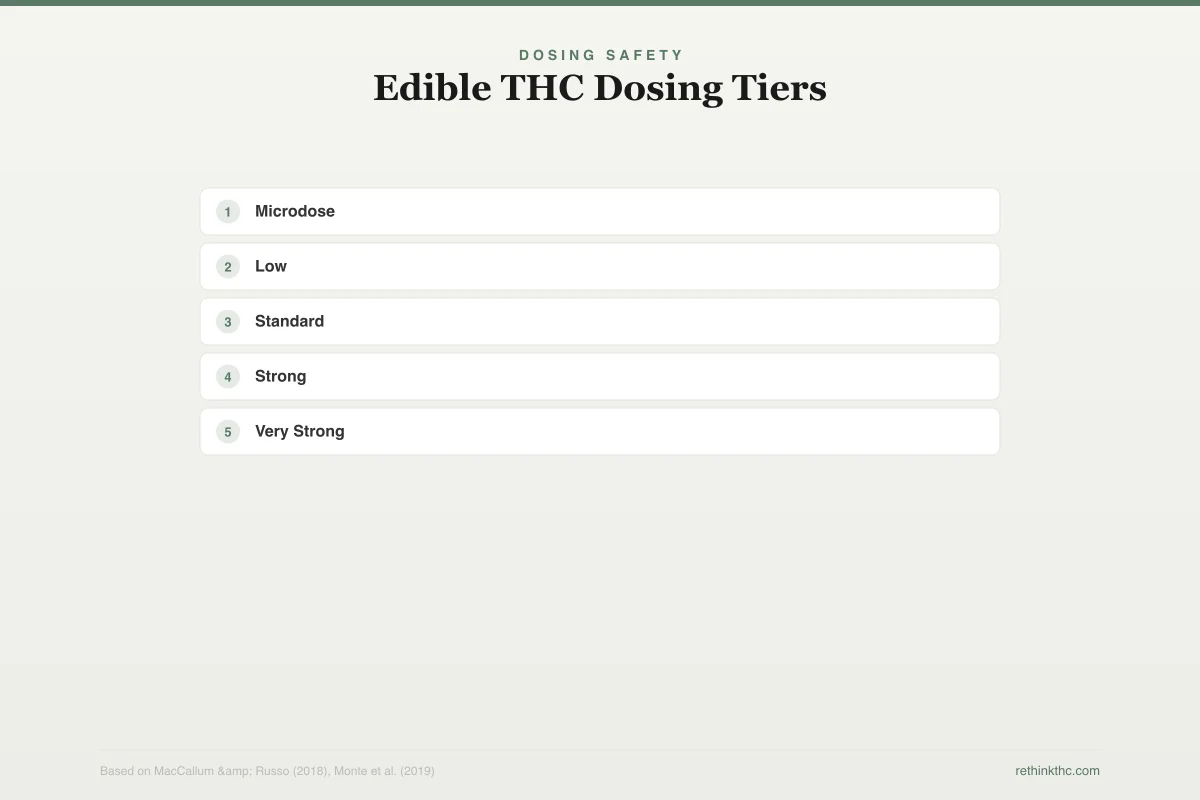
Edible THC Dosing Tiers
Risk increases with dose — onset takes 30 min to 2 hours
1–2.5 mg
Microdose
Subtle relaxation, no impairment
Good starting point for beginners
2.5–5 mg
Low
Mild euphoria, stress relief
Social use, mild symptom relief
5–10 mg
Standard
Noticeable high, impairment possible
Experienced users, standard recreational
10–25 mg
Strong
Intense effects, impairment likely
High-tolerance or medical patients
25+ mg
Very Strong
Overwhelming for most, anxiety risk
Medical use only, very high tolerance
“Start low, go slow” — wait at least 2 hours before re-dosing
Liver converts THC to 11-hydroxy-THC, a more potent metabolite with delayed onset
Based on MacCallum & Russo (2018), Monte et al. (2019)
 View as image ↗
This matters enormously for anyone using cannabis with intention, whether that intention is relaxation, sleep, pain management, or creativity. Overshooting your dose does not just mean a stronger version of the desired effect. It can mean a qualitatively different experience: racing thoughts instead of calm, paranoia instead of social ease, couch-lock instead of gentle relaxation.
The cannabis industry has not helped. Products range from 2.5 mg edibles designed for microdosing to 1,000 mg edibles marketed toward experienced users, and the labeling does not always explain what those numbers mean in practical terms. Regulated markets have improved accuracy, but a 2020 analysis in the Journal of the American Medical Association found that many dispensary products still deviated from labeled potency by 10-25%.
The goal here is to give you evidence-informed starting points that you can adjust based on your own body, tolerance, and objectives. These are not prescriptions. They are guardrails built from the best available clinical data.
The Microdose Range: 1-2.5 mg THC
Microdosing THC has moved from a fringe practice to a legitimate area of clinical interest. At 1-2.5 mg, most people experience subtle shifts in mood, mild stress reduction, and slight enhancements to sensory experience without the cognitive fog or impairment associated with higher doses.
A 2012 study by Portenoy and colleagues, published in The Journal of Pain, examined cancer patients using nabiximols (a THC/CBD spray) at varying doses. The lowest dose group reported significant pain improvement with minimal side effects. The highest dose group actually reported worse outcomes than placebo. This finding, that less THC can produce better therapeutic results, has been replicated across multiple conditions.
Microdosing is particularly relevant for people who need to remain functional: those managing daytime anxiety, mild chronic pain, or creative work. At this range, acute impairment is minimal enough that many users report being able to work, exercise, and socialize normally. Practical guidance: look for edibles or tinctures with clearly labeled 1-2.5 mg servings. Flower and vape products make precise microdosing difficult because inhaled doses are hard to standardize, though single-hit disposable vapes with lab-tested potency can approximate a 1-2 mg dose per puff.
The Standard Dose Range: 5-10 mg THC
The 5-10 mg range is where cannabis becomes a distinctly psychoactive experience for most people. This is the dose range used in most recreational edible products and the range most clinical trials consider a "full dose."
At 5 mg, an infrequent user will typically notice clear euphoria, mild time distortion, enhanced sensory perception, and some impairment of short-term memory and reaction time. At 10 mg, these effects intensify, and many users experience significant relaxation or sedation. For people with no tolerance, 10 mg can be a strong experience, and doses above this threshold carry meaningful risk of adverse effects like paranoia or nausea.
Colorado and other regulated markets settled on 10 mg as a "standard serving" for edibles, but this number was somewhat arbitrary. Research from the University of Colorado Boulder published in 2020 found that occasional users often reported 5 mg as their preferred dose, while daily users gravitated toward 10-25 mg.
The critical variable here is tolerance. Someone who uses cannabis daily for months may need 20-30 mg to achieve effects that a new user gets from 5 mg. This is not a sign that higher doses are "better." Tolerance means your endocannabinoid receptors have downregulated, and taking tolerance breaks of even 48-72 hours can meaningfully reset sensitivity, according to research on CB1 receptor availability using PET imaging published in Molecular Psychiatry.
Dosing for Specific Situations
Different goals call for different dose ranges. Here is what the research suggests for the most common use cases.
Sleep. Sleep is the single most common reason adults give for using cannabis. A 2022 review in Sleep Medicine Reviews found that low-to-moderate THC doses (5-15 mg) reduced sleep onset latency, meaning people fell asleep faster. However, higher doses above 20-30 mg disrupted REM sleep and led to increased next-day fatigue. The sweet spot for most adults appears to be 5-15 mg THC taken 30-90 minutes before bed. Edibles or tinctures are generally preferred over inhalation for sleep because inhaled THC peaks in 5-15 minutes and fades within 1-2 hours, which may not sustain sedation through the night.
Pain. Chronic pain has the deepest evidence base for cannabis use. A landmark 2010 study by Ware and colleagues in the Canadian Medical Association Journal tested smoked cannabis at three THC potencies for neuropathic pain. The medium-potency cannabis, roughly equivalent to 5-8 mg THC per session, produced the best pain relief with manageable side effects. The high-potency condition did not produce better pain relief but did increase dizziness and cognitive impairment. For edible-based pain management, clinical guidance typically suggests starting at 2.5-5 mg and titrating upward by 2.5 mg every 2-3 days. Many patients find relief at 5-15 mg per dose.
Anxiety and mood. This is where THC dosing gets especially tricky because the dose-response curve is biphasic. A frequently cited 2017 study from the University of Illinois at Chicago tested oral THC at 7.5 mg and 12.5 mg in a simulated job interview. The 7.5 mg group reported less stress than placebo. The 12.5 mg group reported more stress than placebo. The difference was just 5 mg, but the outcomes were opposite. If you are using cannabis for anxiety, erring on the low end (2.5-5 mg) is almost always the safer strategy.
Creativity and focus. There is limited controlled research here, but survey data and smaller studies suggest that microdoses (1-3 mg) and very low standard doses (3-5 mg) are most commonly associated with creative enhancement. Higher doses tend to impair executive function and working memory, which are necessary for turning creative insights into coherent output.
Individual Factors That Shift Your Dose
No dosing guide can account for the full range of human variability, but several factors are worth understanding because they can shift your effective dose by a factor of two or more.
CYP2C9 genetic variants. The liver enzyme CYP2C9 is responsible for metabolizing THC into 11-hydroxy-THC, which is actually more potent than THC itself. Roughly 15-20% of people of European descent carry a variant of CYP2C9 that metabolizes THC more slowly. These individuals experience stronger and longer-lasting effects from the same dose. This partly explains why some people report that edibles "hit them harder" than their peers even at identical milligram amounts.
Body composition. THC is lipophilic, meaning it dissolves in fat tissue. People with higher body fat percentages may experience slower onset and longer-lasting effects from edibles because THC distributes into fat stores and releases gradually. However, body weight alone is a poor predictor of dose sensitivity. A 200-pound person with fast hepatic metabolism may process 10 mg of THC faster than a 130-pound person with slower liver enzyme activity.
Food intake. Consuming edibles with fatty food increases THC bioavailability significantly. A 2019 study at the University of Minnesota found that taking a cannabinoid capsule with a high-fat meal increased absorption by 4-5x compared to fasting. This means the same 10 mg gummy could feel notably different on an empty stomach versus after a full meal.
Tolerance. Daily cannabis users develop significant tolerance within days to weeks. CB1 receptor density decreases measurably after sustained THC exposure. The practical implication is that a daily user's 20 mg dose may produce effects comparable to a new user's 5 mg dose. Tolerance breaks of 2-4 weeks can substantially restore baseline sensitivity.
How Delivery Method Changes Everything
The same milligram dose of THC produces different experiences depending on how you consume it. This is not a minor detail. It is arguably as important as the dose itself.
Inhaled (smoking or vaping). THC reaches the brain within seconds. Peak effects occur at 5-15 minutes and typically last 1-3 hours. Bioavailability is roughly 10-35%, varying widely based on inhalation technique. The fast onset makes it easier to titrate in real time: take a puff, wait 10-15 minutes, assess, and decide whether to take another.
Oral (edibles, capsules). THC must pass through the digestive system and liver before reaching the brain. Onset takes 30 minutes to 2 hours, sometimes longer. The liver converts THC into 11-hydroxy-THC, which crosses the blood-brain barrier more readily and produces stronger, longer-lasting effects. This is why a 10 mg edible often feels more intense than 10 mg of inhaled THC. Duration is typically 4-8 hours.
Sublingual (tinctures, strips). When held under the tongue, THC absorbs through mucous membranes and partially bypasses first-pass liver metabolism. Onset is faster than edibles (15-45 minutes) but slower than inhalation. Effects last 2-6 hours. Sublingual delivery offers a middle ground between the controllability of inhalation and the duration of edibles.
Understanding these differences is essential for safe dosing. The most common cannabis overconsumption events happen with edibles, specifically because new users take a dose, feel nothing after 30 minutes, take more, and then experience the combined effects 90 minutes later when everything hits at once.
Building Your Personal Dosing Profile
The most useful dosing data you will ever have is your own. Clinical studies provide population-level ranges, but your individual response depends on a unique combination of genetics, metabolism, tolerance, and context.
A simple approach: keep a brief log for your first 5-10 sessions with any new product or dose. Record the product, dose in milligrams, time of consumption, what you ate beforehand, and a brief note on effects at the 1-hour and 3-hour marks. Within a few entries, patterns emerge that no generic chart can provide.
Start with the lowest dose that makes sense for your experience level. For new users, that is 2.5 mg. For occasional users, 5 mg. For daily users considering a reset, try cutting your usual dose in half after a 48-hour break and see where you land. The overarching principle from clinical research is clear and consistent: with THC, less is frequently more. The dose that produces the best subjective experience and the best therapeutic outcomes is almost always lower than what heavy users assume. Starting low and adjusting upward is not just cautious advice. It is what the data supports.
The Bottom Line
Evidence-based THC dosing guide with milligram ranges by experience level and use case. Non-linear dose-response: 2019 Drug and Alcohol Dependence — doubling dose disproportionately increased anxiety/impairment while only modestly increasing euphoria. Microdose (1-2.5mg): subtle mood/focus effects, minimal impairment; 2012 Portenoy J Pain — lowest dose group had best pain relief. Standard dose (5-10mg): clear psychoactive effects; 10mg = Colorado standard serving but 5mg preferred by occasional users (2020 U of Colorado). Situation-specific: Sleep 5-15mg 30-90min before bed (2022 Sleep Med Rev — above 20-30mg disrupted REM); Pain 2.5-5mg start, titrate by 2.5mg every 2-3 days (2010 Ware CMAJ — medium potency best); Anxiety — biphasic: 2017 U of Illinois — 7.5mg reduced stress, 12.5mg increased stress (5mg difference, opposite outcomes); Creativity 1-3mg. Individual factors: CYP2C9 variants (15-20% of Europeans = slow metabolizers), body composition (lipophilic distribution), food intake (2019 U of Minnesota — high-fat meal increased absorption 4-5x), tolerance (CB1 downregulation). Delivery method changes everything: inhaled (seconds onset, 1-3h, 10-35% bioavailability), oral (30min-2h onset, 4-8h, 11-OH-THC conversion), sublingual (15-45min, 2-6h, partial first-pass bypass). Personal dosing profile: log product/dose/timing/effects for 5-10 sessions.
What is a good starting dose of THC for a complete beginner?
2.5 milligrams is the recommended starting dose for someone with no cannabis tolerance. This is below the standard 5 milligram serving size used in most regulated markets but provides a safer introduction. At 2.5 milligrams, most people experience very mild effects — subtle relaxation, slight mood elevation — without significant impairment. Wait at least 2 hours before considering a second dose if using edibles, or 15 minutes if using inhalation. Many new users find 2.5 to 5 milligrams is their comfortable range. Starting at 10 milligrams, which is a full standard serving, risks an unpleasantly intense experience for someone without tolerance.
Why do edibles hit harder than smoking the same amount of THC?
When you eat THC, your liver converts a significant portion to 11-hydroxy-THC, a metabolite that crosses the blood-brain barrier more efficiently and produces more intense, longer-lasting effects than delta-9-THC itself. When you smoke or vape, THC reaches your brain as unconverted delta-9-THC, bypassing liver metabolism entirely. You are literally experiencing a different active compound through each route. This is why a 10 milligram edible often feels substantially more intense than 10 milligrams of inhaled THC. The delayed onset of edibles (30 minutes to 2+ hours) adds overconsumption risk, as people re-dose before the first dose has fully activated.
How does eating food affect THC dosing?
Food significantly affects THC absorption, especially with edibles. A 2019 University of Minnesota study found that taking a cannabinoid capsule with a high-fat meal increased absorption by 4 to 5 times compared to fasting. This means the same 10 milligram gummy could feel dramatically different on an empty stomach versus after a full meal. For consistent dosing, try to consume edibles under similar conditions each time. If you ate a large fatty meal, consider reducing your dose. If you are dosing on an empty stomach, the onset may be faster but the total absorption lower.
What is the biphasic effect and why does it matter for dosing?
The biphasic effect means THC produces opposite effects at different doses. At low doses (roughly 2.5 to 7.5 milligrams), THC tends to reduce anxiety and promote relaxation. At higher doses (above 12.5 milligrams for many users), it tends to increase anxiety, paranoia, and cognitive impairment. A frequently cited 2017 University of Illinois study demonstrated this precisely: 7.5 milligrams of oral THC reduced stress in a simulated job interview, while 12.5 milligrams increased stress compared to placebo. The difference was just 5 milligrams. This is why "more is better" thinking is particularly dangerous with cannabis — crossing the threshold from anxiolytic to anxiogenic can happen with a small dose increase.
How long should a tolerance break be to reset THC sensitivity?
Research using PET brain imaging has shown that CB1 receptor availability begins recovering within 48 hours of abstinence, with most brain regions returning to near-normal levels after approximately 28 days. A 2012 study in Molecular Psychiatry by Hirvonen and colleagues confirmed this timeline. For practical purposes, even a 48 to 72-hour break can produce a noticeable reduction in tolerance, allowing you to achieve desired effects at lower doses. A 2-week break provides substantial receptor recovery. A full 4-week break returns most users to near-baseline sensitivity. After a tolerance break, restart at the lowest effective dose rather than returning to your pre-break consumption level.
Can you microdose THC and still function normally at work?
At the microdose range of 1 to 2.5 milligrams, most users report subtle mood and focus effects without significant cognitive impairment. A 2012 study by Portenoy and colleagues found that the lowest dose group in a cancer pain trial reported symptom improvement with minimal side effects. However, individual response varies substantially based on genetics, tolerance, and sensitivity. Some people feel noticeably impaired at 2.5 milligrams while others feel nothing. Additionally, any level of THC consumption creates legal and employment liability — most workplace drug policies do not distinguish between microdosing and heavy use. If drug testing is a possibility, any THC consumption carries risk regardless of dose.
Sources & References
- 1RTHC-07874·Vikingsson, Svante et al. (2025). “Legal CBD Products With Trace THC Can Cause Positive Drug Tests in Oral Fluid.” Journal of analytical toxicology.Study breakdown →PubMed →↩
- 2RTHC-07964·Wolinsky, David et al. (2025). “How CBD and Low-Dose THC From Hemp Products Affect Drug Tests and the Body.” Journal of analytical toxicology.Study breakdown →PubMed →↩
- 3RTHC-06120·Brooks-Russell, Ashley et al. (2025). “Daily Cannabis Users Showed Little Driving Impairment After Using High-Potency Products.” Traffic injury prevention.Study breakdown →PubMed →↩
- 4RTHC-06239·Coates, Shelby et al. (2025). “THC and CBD can inhibit hydromorphone metabolism, potentially increasing opioid levels by 20-30%.” Drug metabolism and disposition: the biological fate of chemicals.Study breakdown →PubMed →↩
- 5RTHC-08128·Bogenschutz, Michael P et al. (2026). “CBD Up to 1200mg Daily Failed to Beat Placebo for Alcohol Addiction or PTSD.” Alcohol.Study breakdown →PubMed →↩
- 6RTHC-08245·Earl, Mason et al. (2026). “Daily Cannabis Use Linked to 40% Higher Heart Disease Risk in Adults Under 50.” Preventive medicine.Study breakdown →PubMed →↩
- 7RTHC-08252·ElHassan, Nahed O et al. (2026). “Pregnant Women With Medical Cannabis Cards Bought 137mg THC Daily on Average.” American journal of obstetrics & gynecology MFM.Study breakdown →PubMed →↩
- 8RTHC-08278·Gillham, Scott H et al. (2026). “Daily CBD Supplement Use Can Trigger Positive Drug Tests for Athletes.” Medicine and science in sports and exercise.Study breakdown →PubMed →↩