Special Populations
No Benefit
Cannabis does not improve athletic performance in any measurable way, and athletes are a high-risk group for dependence because pain, stress, and sports culture create the perfect setup for habitual use.
Kennedy, Journal of Science and Medicine in Sport, 2017
Does Cannabis Improve Athletic Performance?
covered in detail
Moving Forward
covered in detail
Evidence-based
peer-reviewed research
Kennedy, Journal of Science and Medicine in Sport, 2017
 View as image ↗
If you only read one thing
Cannabis does not make you a better athlete. Zero out of 15 studies found any performance improvement from THC — it actually slows your reaction time and reduces coordination. Many athletes use it for pain and sleep after training, but the recovery evidence is mostly self-reported and the sleep benefit is a trap: THC helps you fall asleep but suppresses the deep sleep stages your body needs to actually repair. Athletes are especially prone to getting dependent because pain, stress, and sports culture create the perfect daily-use pattern.
The relationship between athletes and cannabis has shifted faster than almost any other area of drug policy. A decade ago, a positive THC test could end a career. Today, major professional leagues have largely stopped punishing players for cannabis use, and a growing number of athletes openly discuss using it for recovery and pain management. But the cultural shift has outpaced the science. The question of whether cannabis actually helps athletic performance and recovery, and what happens when athletes who depend on it try to quit, deserves a more careful look than most coverage provides.
This is not about whether athletes "should" or "should not" use cannabis. It is about what the evidence actually shows, where the real risks are, and what you are facing if you are an athlete trying to stop.
Key Takeaways
- Cannabis does not improve athletic performance in any measurable way — research shows THC actually impairs reaction time, coordination, and maximal exercise capacity
- WADA raised its THC threshold in 2024 from 150 to 180 ng/mL, and the NFL, NBA, and MLB have all softened or dropped cannabis testing and penalties
- Athletes are a high-risk group for cannabis dependence because pain, stress, and sports culture create the perfect setup for habitual use to take hold
- Cannabis may reduce inflammation and subjective pain after training, but the evidence for meaningful recovery benefits is still preliminary and mostly self-reported
- Quitting as an athlete brings specific challenges: withdrawal-related sleep disruption directly undermines physical recovery, and the return of untreated pain can feel overwhelming
- A 2017 systematic review by Kennedy in the Journal of Science and Medicine in Sport found no evidence that THC enhances any aspect of athletic performance, and documented impaired exercise capacity, reduced coordination, and slower reaction time
Does Cannabis Improve Athletic Performance?
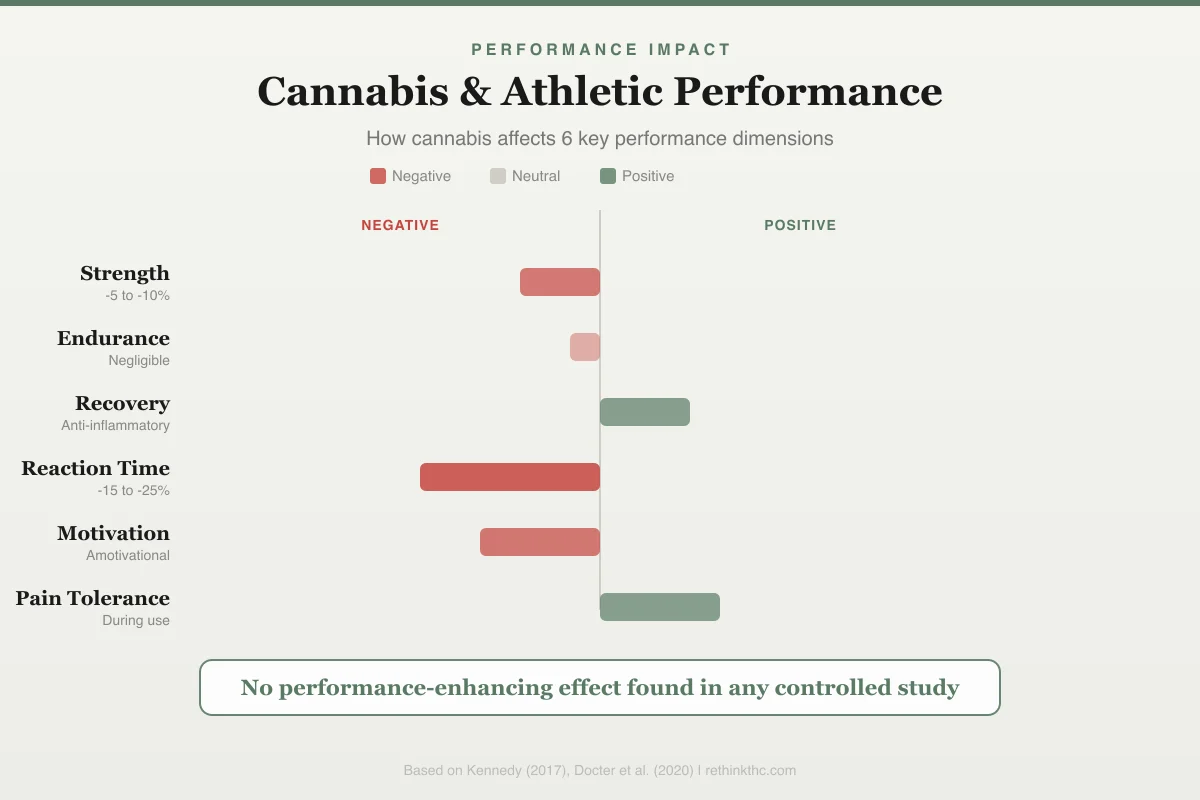
The short answer is no. There is no published research demonstrating that THC enhances any measurable aspect of athletic performance. A 2017 systematic review by Kennedy in the Journal of Science and Medicine in Sport examined the available literature and concluded that cannabis use was associated with impaired exercise capacity, reduced coordination, and slower reaction time.[1]
Performance Impact
Cannabis & Athletic Performance
How cannabis affects 6 key performance dimensions
Strength
-5 to -10%
Endurance
Negligible
Recovery
Anti-inflammatory
Reaction Time
-15 to -25%
Motivation
Amotivational
Pain Tolerance
Increased
No performance-enhancing effect found in any controlled study
Based on Kennedy (2017), Docter et al. (2020)
View as image ↗THC acts on CB1 receptors throughout the brain, including areas that govern motor control and timing. A 2021 study by Kramer and colleagues in Clinical Journal of Sport Medicine found that acute cannabis intoxication reduced hand-eye coordination and increased time-to-exhaustion, meaning athletes reached fatigue faster, not slower.
Some athletes report that cannabis helps them "get in the zone" during training, reducing anxiety and increasing focus. This subjective experience is real, but it does not translate to measurable performance gains. For sport-specific breakdowns, see THC and exercise, THC and running, THC and weightlifting, and THC and golf. What cannabis is doing in those cases is lowering perceived effort and reducing performance anxiety, which can feel productive while actually masking reduced output. Musicians and other creative performers describe a similar dynamic, and the creativity after quitting guide explores how creative output often improves once the crutch is removed.
Kennedy (2017) · Journal of Science and Medicine in Sport
- Population
- 15 published studies involving formal exercise protocols
- Intervention
- THC use before or during exercise
- Comparator
- Non-use or placebo
- Finding
- Zero studies showed aerobic improvement. Strength was probably reduced. Cannabis triggered chest pain at lower workloads in all cardiac-vulnerable subjects tested. Some participants could not finish exercise protocols due to adverse reactions.
positive Clear finding despite small evidence base — no performance benefit found in any study
Kennedy (2017), Journal of Science and Medicine in Sport, 20(9), 825-829
The one area where cannabis may have a theoretical edge is in ultra-endurance events. Some researchers have speculated that THC's anti-inflammatory properties and pain-dampening effects could help athletes push through long-duration activities. But this remains speculation. No controlled study has demonstrated an endurance benefit, and the World Anti-Doping Agency's own review concluded that cannabis is more likely to impair performance than enhance it.
The Policy Revolution: WADA, NFL, NBA, and NCAA
The rules around cannabis in sports have changed dramatically, and understanding where things stand matters if you are competing at any level.
Policy Changes
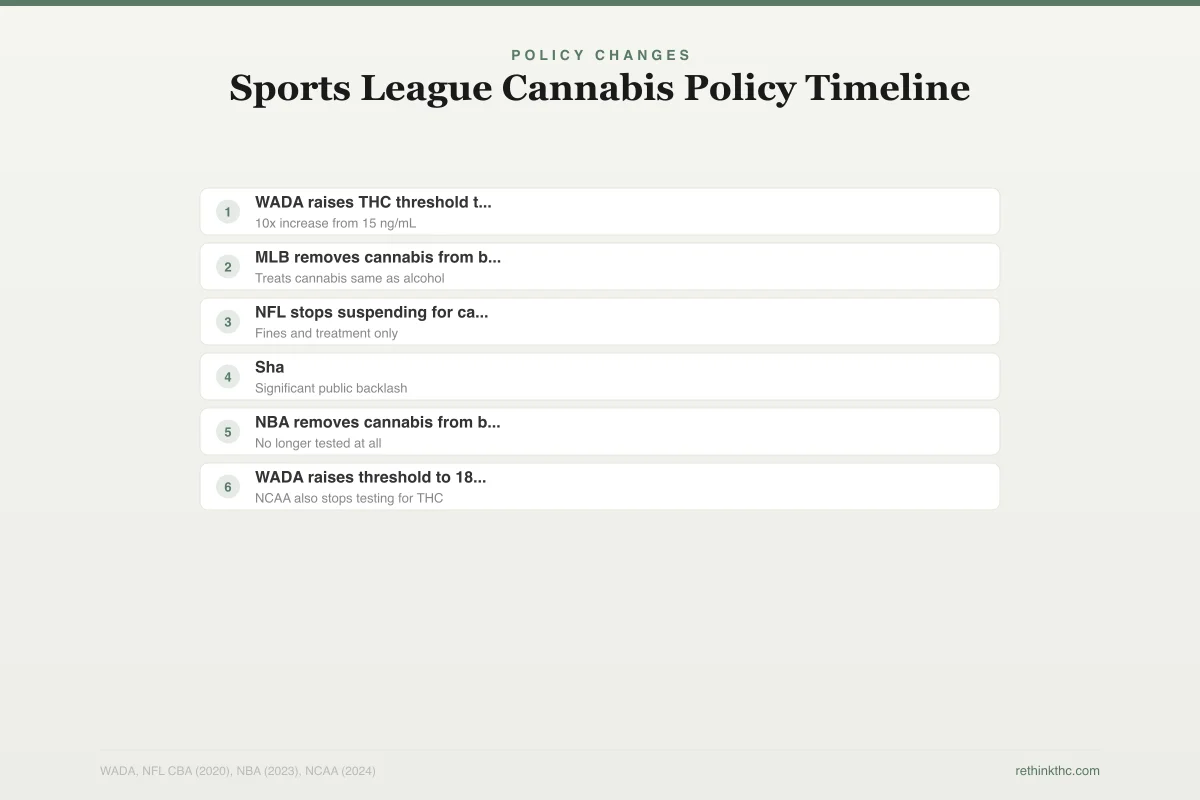
Sports League Cannabis Policy Timeline
Major shifts from prohibition toward tolerance
2013
WADA raises THC threshold to 150 ng/mL
10x increase from 15 ng/mL
2019
MLB removes cannabis from banned list
Treats cannabis same as alcohol
2020
NFL stops suspending for cannabis
Fines and treatment only
2021
Sha'Carri Richardson suspended
Significant public backlash
2023
NBA removes cannabis from banned list
No longer tested at all
2024
WADA raises threshold to 180 ng/mL
NCAA also stops testing for THC
WADA, NFL CBA (2020), NBA (2023), NCAA (2024)
 View as image ↗
WADA and the Olympics
The World Anti-Doping Agency (WADA) has kept cannabis on its prohibited list since 2004, but only during competition. Out-of-competition use is not banned. In 2013, WADA raised the allowable THC threshold from 15 ng/mL to 150 ng/mL, a tenfold increase specifically designed to catch only athletes who used cannabis on or near competition day. In 2024, WADA raised the threshold again to 180 ng/mL, further reducing the likelihood of a positive test from casual or off-season use.
The Sha'Carri Richardson case in 2021, where a sprinter was suspended from the Olympics after testing positive for THC, accelerated this conversation. The public backlash was significant, and WADA's subsequent threshold increase was widely interpreted as a direct response.
Professional Leagues
The NFL stopped suspending players for positive cannabis tests in its 2020 collective bargaining agreement. Testing still occurs during a limited window, but violations now result in fines and treatment referrals, not suspensions. The NBA went further, removing cannabis from its banned substance list entirely in 2023. MLB had already removed cannabis from its list of drugs of abuse in 2019 and treats it the same as alcohol.
NCAA
The NCAA announced in 2024 that it would no longer include THC in its standard drug testing panels. Individual schools can still test for cannabis under their own policies, but the national governing body effectively stopped treating it as a competitive concern. This was a major shift for the roughly 500,000 college athletes in the United States.
These policy changes reflect a growing institutional consensus that cannabis is not a performance-enhancing drug. But the removal of institutional penalties has also removed a guardrail that, for some athletes, was the primary reason they moderated their use.
Cannabis for Recovery: What the Evidence Actually Shows
This is where athlete interest is highest and the science is most frustratingly incomplete.
Athletic Metrics
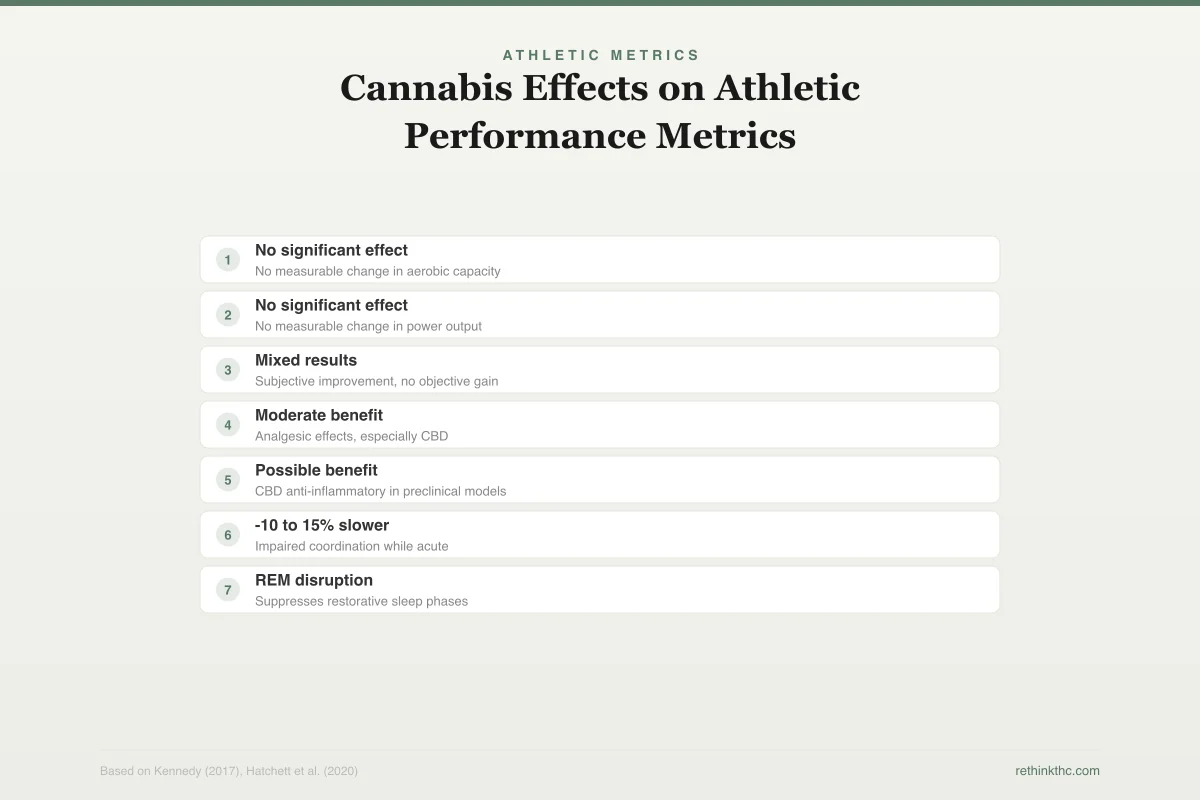
Cannabis Effects on Athletic Performance Metrics
Evidence-based impact assessment across 7 key areas
VO2 Max
No measurable change in aerobic capacity
No significant effect
Strength
No measurable change in power output
No significant effect
Endurance
Subjective improvement, no objective gain
Mixed results
Pain Mgmt
Analgesic effects, especially CBD
Moderate benefit
Recovery (Inflammation)
CBD anti-inflammatory in preclinical models
Possible benefit
Reaction Time
Impaired coordination while acute
-10 to 15% slower
Recovery (Sleep)
Suppresses restorative sleep phases
REM disruption
Based on Kennedy (2017), Hatchett et al. (2020)
 View as image ↗
Pain and Inflammation
Athletes experience significant physical pain, both acute injuries and chronic wear from training. Cannabis, particularly CBD, has demonstrated anti-inflammatory properties in preclinical studies. A 2020 review by Hatchett and colleagues in the Journal of Cannabis Research found that cannabinoids reduced inflammatory markers in laboratory and animal models. The relevance to human athletic recovery, however, has not been established through rigorous clinical trials.
For a broader look at what the research says about cannabis and pain management, the evidence base is covered in cannabis and chronic pain research. The takeaway is that cannabis may help with certain types of chronic pain, but the evidence is stronger for neuropathic pain than for musculoskeletal pain, which is the primary type athletes deal with.
Sleep
Many athletes report using cannabis specifically to improve sleep quality and recovery. Sleep is when the body does its most critical repair work, and poor sleep directly impairs athletic recovery, hormone production, and cognitive function. The relationship between cannabis and sleep is more complicated than most athletes realize. THC helps you fall asleep faster but suppresses REM sleep, the phase most closely tied to memory consolidation and emotional regulation. The full picture is covered in does cannabis help with sleep.
For athletes, the short-term sedative effect of THC may create the perception of better recovery while actually reducing sleep quality over time. A 2023 study by Suraev and colleagues in the Journal of Clinical Sleep Medicine found that chronic cannabis users had worse objective sleep quality than non-users, despite reporting higher subjective satisfaction with their sleep.
The Self-Report Problem
Most evidence for cannabis-aided recovery in athletes comes from surveys and self-reports, not controlled studies. A 2019 survey by Zeiger and colleagues in the Journal of Cannabis Research found that 26% of surveyed athletes reported using cannabis for recovery purposes, with pain relief and sleep improvement cited most frequently. But self-reported benefits and measured outcomes are different things, and the placebo effect in pain and sleep research is substantial.
The honest summary: cannabis may help some athletes manage pain and fall asleep, but we do not have strong evidence that it improves actual recovery outcomes like muscle repair, reduced injury rates, or faster return to training.
Fact Check
The locker room claim vs. the research
The claim
“Cannabis is a recovery tool — it reduces inflammation, helps you sleep, and speeds healing”
Athlete testimonials, CBD brand marketing, and sports culture
What research shows
OverstatedCannabinoids reduce inflammatory markers in lab and animal studies, but no rigorous human trial has shown faster muscle repair or reduced injury rates. THC helps you fall asleep faster but suppresses the REM sleep your body needs for physical recovery. Most athlete recovery evidence comes from self-report surveys, not objective measurements.
The anti-inflammatory signal from preclinical research is real and worth investigating. But 'reduces inflammation in a petri dish' is very different from 'speeds recovery after a training session.' The sleep tradeoff is especially problematic for athletes because sleep quality directly determines recovery quality.
Hatchett et al. (2020), Journal of Cannabis Research; Suraev et al. (2023), Journal of Clinical Sleep Medicine
Evidence Review
Where the evidence stands
Cell & Lab Studies
Cannabinoids reduce inflammatory markers in lab models
Animal Studies
Anti-inflammatory and analgesic effects confirmed in rodent models
Athlete Surveys & Self-Reports
26% of athletes report using cannabis for recovery (Zeiger 2019), but subjective
Controlled Human Trials
No controlled trials measuring cannabis effects on athletic recovery outcomes
Large Athletic Performance RCTs
Only 15 exercise studies exist total (Kennedy 2017) — none showed performance benefit
Meta-Analysis
Not enough controlled trials to synthesize
We have preclinical evidence that cannabinoids reduce inflammation and survey data showing athletes believe cannabis helps recovery. But we are missing the controlled human trials that would tell us whether cannabis actually speeds healing, reduces injury rates, or improves training outcomes. The gap between what athletes report and what has been measured is the biggest problem in this research area.
Kennedy (2017), Hatchett et al. (2020), Zeiger et al. (2019)
Why Athletes Are a High-Risk Group for Dependence
Athletes face a combination of risk factors that make cannabis dependence more likely than in the general population.
Withdrawal & Athletics
Athlete-Specific Withdrawal Challenges
How cannabis withdrawal uniquely impacts athletic performance
Sleep Disruption
Impairs recovery windows and growth hormone release
Peaks days 2–6, resolves by week 3–4
Increased Pain Perception
Unmasked training pain affects load management
Immediate onset, stabilizes by week 2–3
Appetite Changes
Disrupts nutrition timing and caloric intake
Peaks week 1, normalizes by week 2–3
Anxiety
Affects competition performance and pre-game focus
Peaks week 1–2, improves by week 3–4
Motivation Changes
Affects training consistency and discipline
Variable, often improves after week 2
Reduce training volume weeks 1–3 — exercise at moderate intensity aids withdrawal recovery
Based on Budney et al. (2004), Kennedy (2017)
 View as image ↗
Chronic pain creates a use pattern. Athletes are in pain regularly. Using cannabis for pain relief after training or competition creates a daily use pattern, and daily use is the single strongest predictor of developing cannabis dependence. What starts as post-workout relief becomes something your body expects and your brain builds around.
Stress and performance pressure. Competitive athletics involve enormous psychological pressure. Cannabis becomes a way to decompress, manage anxiety, and "turn off" after high-intensity days. This is classic self-medication, and it follows the same pattern described in why people self-medicate with weed. Healthcare workers face a similar dynamic, and the nurses and healthcare workers guide to weed addiction explores how high-stress professions create the same conditions for habitual use.
Sports culture normalizes use. In many locker rooms and training environments, cannabis use is not just tolerated but actively encouraged. When everyone around you is using, it becomes difficult to recognize when your own use has crossed from recreational to dependent.
Retirement creates a crisis point. Many former athletes report that cannabis use escalated after retirement, when the structure of training disappeared but the pain, identity loss, and mental health challenges remained. The transition out of sport mirrors other major career transitions where cannabis use becomes entangled with professional identity, as covered in quitting weed for your career. College athletes face a parallel version of this where academic performance and athletic eligibility intersect, and the quitting weed as a college student guide addresses that specific pressure.
Quitting Cannabis as an Athlete: What to Expect
If you are an athlete who has decided to quit or cut back on cannabis, the withdrawal experience comes with sport-specific complications.
Sleep Disruption Hits Recovery Hard
Withdrawal insomnia is one of the most common and persistent symptoms of cannabis withdrawal. For athletes, this is not just an inconvenience. Sleep is when growth hormone is released, when muscle tissue repairs, and when the central nervous system recovers from training stress. Expect your recovery between sessions to feel noticeably worse for the first two to four weeks after quitting. This is temporary, but it is real, and you may need to reduce training volume during this period.
Safety
ModerateWithdrawal sleep disruption undermines physical recovery
Concern
When athletes quit cannabis, withdrawal insomnia typically lasts 2 to 4 weeks. During this window, growth hormone release, muscle repair, and central nervous system recovery are all compromised because they depend on quality sleep. Training through this period without adjusting volume and intensity risks overtraining, injury, and relapse.
What the research says
The sleep disruption is temporary and follows a predictable timeline — worst in week 1, steadily improving through weeks 2 to 4. Reducing training volume to moderate intensity during this period and using sleep hygiene strategies can bridge the gap. Most athletes report sleep quality that equals or exceeds their cannabis-assisted baseline by week 4 to 6.
Particularly relevant for: Athletes who use cannabis nightly and are planning to quit or reduce
What to do
Plan your quit around a lighter training phase if possible. Drop to 60-70% intensity for weeks 1 to 3. Prioritize sleep hygiene: consistent wake time, cool dark room, no screens before bed. Consider melatonin as a short-term bridge. Do not make the decision to restart during the first week — it is the worst point, not the new normal.
Gates et al. (2016), Substance Abuse; Suraev et al. (2023), Journal of Clinical Sleep Medicine
Untreated Pain Returns
If you were using cannabis to manage training-related pain, that pain is going to come back when you stop. This is one of the most common reasons athletes relapse. The pain was there before the cannabis; the cannabis was masking it. You will need alternative pain management strategies, whether that is physical therapy, ice/heat protocols, NSAIDs, or working with a sports medicine provider.
Exercise Becomes Your Best Tool
Here is the good news. Exercise is one of the most effective tools for managing cannabis withdrawal. Physical activity triggers natural endocannabinoid release, produces endorphins, improves mood, and helps regulate sleep. As an athlete, you already have the habit of regular movement. Your body's ability to produce its own feel-good chemicals through exercise gives you an advantage that most people quitting cannabis do not have.
The key is adjusting intensity during the first few weeks. Withdrawal symptoms like disrupted sleep, reduced appetite, and increased anxiety can make high-intensity training feel brutal. If you are finding that work anxiety during withdrawal is affecting both your training and your professional life, that is a common overlap that deserves its own set of strategies. Drop to moderate intensity for weeks one through three, then gradually rebuild.
The Anti-Doping Factor
If you are competing in a sport that still tests for THC, quitting creates a practical timeline consideration. THC is fat-soluble, meaning it is stored in adipose tissue and released slowly. For athletes with low body fat who exercise frequently, clearance can be faster than the general population, but heavy users may still test positive for 30 or more days after stopping. The specific detection windows depend on testing methodology, frequency of prior use, and individual metabolism.
When to Seek Professional Help
Quitting cannabis is manageable for most people, but some situations require professional support. Talk to a healthcare provider if withdrawal symptoms are severe enough to interfere with your ability to train or function for more than four weeks, if you experience depression that worsens rather than improves after the first two weeks, if you are dealing with chronic pain that feels unmanageable without cannabis, or if you have tried to quit multiple times and cannot make it stick.
Athletes often hesitate to seek help because of the stigma around substance use in sports. A sports psychologist or addiction medicine specialist who understands the athletic context can make a significant difference.
SAMHSA National Helpline: 1-800-662-4357 (free, confidential, 24/7)
Moving Forward
The world of sports and cannabis is in a transitional period. The policies have changed. The cultural attitudes have changed. But the biology has not. Cannabis does not enhance performance, the recovery evidence is preliminary at best, and athletes who use daily are at elevated risk for dependence.
If you are an athlete who has been using cannabis regularly and you are reconsidering that relationship, you are not giving something up. You are finding out what your body and your performance look like when your own systems are running the show. The withdrawal period is temporary. Your athletic career, your sleep, and your recovery all stand to benefit on the other side.
Research Gaps
What would it take?
What would it take to know if cannabis actually helps athletic recovery?
Controlled trial measuring muscle repair, inflammatory markers, and return-to-training time in athletes using cannabis vs. placebo
All current recovery evidence is self-reported — no study has measured objective recovery outcomes
Head-to-head comparison of cannabis vs. standard recovery protocols (ice, compression, NSAIDs, sleep optimization)
No study has compared cannabis recovery to what athletes already use
Long-term study of sleep architecture in athletes using cannabis nightly vs. non-users, with performance tracking
We know THC suppresses REM sleep generally, but athlete-specific data on how this affects training adaptation is absent
Dose-response data separating THC, CBD, and ratio products for athletic recovery
CBD and THC have very different mechanisms — lumping them together obscures the picture
Prospective cohort tracking dependence rates in athlete populations over multiple seasons
Survey data suggests athletes are high-risk, but prospective tracking through career phases is needed
Based on research gaps identified in Kennedy (2017) and Hatchett et al. (2020)
The Bottom Line
Cannabis does not improve athletic performance — Kennedy 2017 systematic review (Journal of Science and Medicine in Sport) found THC associated with impaired exercise capacity, reduced coordination, and slower reaction time. Subjective "zone" experiences reflect reduced perceived effort and performance anxiety, not actual performance gains. Policy revolution: WADA raised THC threshold to 180 ng/mL (2024), NFL stopped suspensions (2020 CBA), NBA removed cannabis from banned list (2023), MLB removed it (2019), NCAA dropped THC from testing panels (2024). Recovery evidence is preliminary: cannabinoids reduce inflammatory markers in preclinical models (Hatchett 2020, Journal of Cannabis Research) but no rigorous human trials; THC helps falling asleep but suppresses REM sleep critical for physical recovery (Suraev 2023, Journal of Clinical Sleep Medicine — chronic users had worse objective sleep despite higher subjective satisfaction); most athlete recovery evidence is self-reported (Zeiger 2019 survey: 26% of athletes reported recovery use). Athletes are high-risk for dependence: chronic pain creates daily use patterns, performance pressure drives self-medication, sports culture normalizes use, retirement removes structure while pain/identity loss persist. Athlete-specific withdrawal challenges: sleep disruption directly impairs physical recovery (reduce training volume for 2-4 weeks), untreated pain returns (need alternative pain management), but exercise is a major advantage (natural endocannabinoid release, endorphins, mood and sleep regulation). THC clearance: fat-soluble, athletes with low body fat clear faster but heavy users may test positive 30+ days.
Can cannabis help with post-workout recovery?
Cannabis may reduce subjective pain and help with falling asleep, both of which athletes associate with recovery. However, there is limited clinical evidence that cannabis improves objective recovery markers like muscle repair, reduced inflammation in humans, or faster return to baseline performance. THC also suppresses REM sleep, which is critical for physical and cognitive recovery. The evidence base is covered more thoroughly in medical benefits of cannabis.
Will quitting weed affect my athletic performance?
In the short term, yes. Withdrawal symptoms like sleep disruption, anxiety, and reduced appetite can impair training quality and recovery for two to four weeks. After that adjustment period, most athletes report improved reaction time, better sleep quality, clearer focus during training, and more consistent energy levels. The temporary dip is followed by a meaningful baseline improvement.
How long does THC stay in an athlete's system?
It depends on usage frequency, body fat percentage, and exercise habits. Occasional users may clear THC in 3 to 10 days. Daily heavy users can test positive for 30 to 60 or more days. Athletes with low body fat and high activity levels tend to clear THC faster, but intense exercise can temporarily spike THC blood levels by releasing it from fat stores during workouts.
Is CBD a better option for athletes than THC?
CBD does not produce intoxication, is not banned by WADA or any major professional league, and has shown anti-inflammatory properties in preclinical research. It is a more practical option for athletes concerned about impairment, drug testing, or dependence. However, the clinical evidence for CBD's athletic recovery benefits is still developing, and many CBD products contain trace amounts of THC that could accumulate with heavy use.
Do professional athletes actually use cannabis regularly?
Survey data suggests yes. A 2019 study by Zeiger and colleagues found that over 25% of athletes surveyed reported current cannabis use, with pain management and sleep cited as primary reasons. Anonymous surveys in the NFL have estimated even higher usage rates. The removal of cannabis from banned substance lists across major leagues has made open discussion more common, though exact prevalence is difficult to measure.
Does exercise during cannabis withdrawal help with symptoms?
Yes. Exercise is one of the most effective tools for managing cannabis withdrawal because physical activity triggers natural endocannabinoid release, produces endorphins, improves mood, and helps regulate sleep.[1] Athletes have a significant advantage here because the habit of regular movement is already established. The key is adjusting intensity during the first two to three weeks — withdrawal symptoms like disrupted sleep and reduced appetite make high-intensity training feel significantly harder, so dropping to moderate intensity and gradually rebuilding is the recommended approach.
Sources & References
- 1RTHC-01417·Kennedy, Michael C (2017). “Does Cannabis Improve Athletic or Exercise Performance? The Evidence Says No.” Journal of science and medicine in sport.Study breakdown →PubMed →↩