Product Types
16%
A 2020 study found people smoking 16% and 24% THC flower reached similar blood levels and reported nearly identical highs, suggesting the highest number on the menu may not get you more.
Bidwell et al., JAMA Psychiatry, 2020
16%
A 2020 University of Colorado study found that people
Why THC Percentage Is Misleading
covered in detail
Reading a Certificate of Analysis
covered in detail
Bidwell et al., JAMA Psychiatry, 2020
 View as image ↗
A dispensary menu can look like a restaurant menu written in a foreign language. Strain names that sound made up. THC percentages that seem to be the only metric anyone cares about. Indica, sativa, and hybrid labels that promise specific effects. Terpene profiles that may or may not mean anything. And price tiers that do not always correspond to quality in any obvious way.
Most consumers default to the simplest heuristic: pick the highest THC percentage in the indica or sativa category they want, at a price they can afford. This approach misses most of what actually matters. This guide explains what the different pieces of information on a dispensary menu mean, which ones are scientifically useful, and how to make better choices.
Key Takeaways
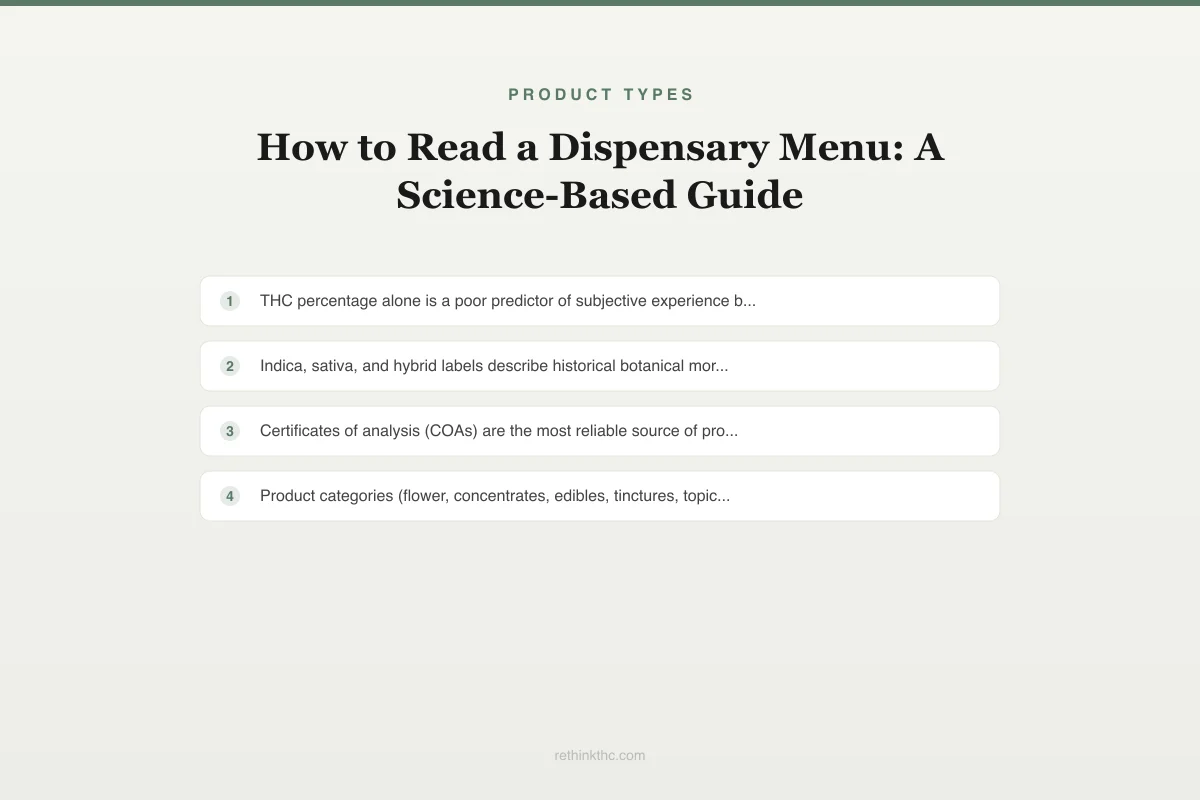
- THC percentage by itself doesn't tell you much about how a product will feel, because it ignores terpenes, minor cannabinoids, and your own body chemistry
- Indica, sativa, and hybrid labels describe what the plant looks like, not what it does to you — decades of crossbreeding have made these categories chemically meaningless
- Certificates of analysis (COAs) are the most reliable info you can get on a product, showing exact cannabinoid and terpene concentrations from third-party lab testing
- The type of product you choose — flower, concentrates, edibles, tinctures, topicals — affects onset time, duration, and dosing precision far more than which strain you pick
- Asking a budtender about terpene profiles, cannabinoid ratios, and lab test results gives you way more useful info than asking if something is a "good indica"
- A 2020 University of Colorado study found that people smoking 16% and 24% THC flower ended up with similar blood THC levels and felt about the same level of high — so chasing the highest number on the menu doesn't actually get you more
Why THC Percentage Is Misleading
Dispensary Menu: What Actually Matters
Users of 16% and 24% flower felt similarly high (Bidwell 2020)
Labels don't match genetics (Sawler 2015) or chemistry (Hazekamp 2019)
Reliably predicts smell and taste; effect claims still unproven in humans
CBD demonstrably modulates THC effects — most useful single metric
Only objective, batch-specific data — the gold standard
THC percentage is the number most consumers fixate on. Higher THC should mean a stronger effect, which should mean better value. This logic seems straightforward, and it is mostly wrong.
The problem is not that THC content does not matter at all. It does. A product with 30% THC will deliver more THC per gram than one with 15% THC, all else being equal. The problem is that all else is never equal, and THC percentage alone explains surprisingly little about how a product will feel.
A 2020 study by Bidwell and colleagues at the University of Colorado Boulder examined the relationship between THC concentration in cannabis flower and the actual intoxication experienced by users. Participants were assigned to use either moderate-potency (16% THC) or high-potency (24% THC) flower. Both groups achieved similar blood THC levels and reported similar levels of intoxication. The higher-potency group did not get meaningfully more impaired.
Why? Several reasons. People tend to self-titrate, taking smaller or fewer hits of stronger products. Combustion and vaporization efficiency vary. And the subjective experience is influenced by other compounds in the product, by individual tolerance, by mindset and setting, and by how the THC is metabolized, none of which is captured by a THC percentage.
Dispensary menus that sort products by THC percentage encourage a simplistic view. A 30% THC flower is not necessarily a better product than an 18% THC flower. It contains more THC per gram, but the experience depends on far more than that single number.
Indica, Sativa, and Hybrid: What These Labels Actually Mean
The indica/sativa classification is the most entrenched and least useful labeling system in cannabis. The popular understanding goes like this: indica is relaxing and sedating ("in-da-couch"), sativa is energizing and uplifting, and hybrid is somewhere in between.
The original distinction was botanical. Cannabis indica plants, adapted to harsh Central Asian climates, grow short and bushy with broad leaves. Cannabis sativa plants, from equatorial regions, grow tall and lanky with narrow leaves. This morphological difference is real, but it describes plant shape, not pharmacological effect.
Decades of crossbreeding have made the indica/sativa genetic distinction nearly meaningless for commercial products. Sawler and colleagues published a 2015 study in PLOS ONE analyzing the genetic profiles of 81 commercial cannabis strains and found that the reported sativa/indica labels did not reliably correspond to their genetic ancestry. Some labeled indicas were genetically closer to sativas, and vice versa.
More importantly, the chemical profiles of products labeled indica versus sativa do not consistently differ in ways that would predict different effects. A 2019 analysis by Hazekamp and colleagues found that terpene profiles varied across cultivars but did not cluster into neat indica/sativa categories.
What likely drives the subjective difference people report between indica and sativa products is a combination of terpene content, cannabinoid ratios, dose, delivery method, and expectation. When you have a relaxing experience with something labeled indica, you are not experiencing an indica effect. You are experiencing the specific chemical profile of that particular product interacting with your particular biology and your particular expectations.
Use indica/sativa labels as rough starting points if you want, but do not treat them as reliable pharmacological predictions.
Reading a Certificate of Analysis
A certificate of analysis (COA) is the most objective information you can get about a cannabis product. It is a lab report showing the concentrations of cannabinoids, terpenes, and potential contaminants in a specific batch.
In regulated markets, products must be tested by licensed third-party laboratories. The COA typically includes cannabinoid potency (THC, THCA, CBD, CBDA, CBG, CBN, and others), terpene profile and concentrations, residual solvent levels, pesticide screening, heavy metal testing, microbial contamination testing, and moisture content.
The cannabinoid section tells you what the product actually contains, not what the strain name implies. Two batches of the same strain from the same grower can have different cannabinoid profiles. The COA for your specific batch is the only reliable measure.
A few things to watch for when reading a COA. THCA is the precursor to THC. When heated (by smoking, vaping, or cooking), THCA converts to THC. Menus may list total THC, which accounts for this conversion, or just delta-9 THC, which does not. Total THC is the more useful number for predicting potency. The conversion factor is roughly: total THC = delta-9 THC + (THCA x 0.877).
Terpene results show you what the product will smell and taste like and provide the only chemical basis for predicting effect differences between products. For more on what terpene profiles mean, see terpenes explained.
If a dispensary makes COAs available, either posted on their website or available upon request, that is a sign of transparency. If they cannot or will not provide batch-specific lab results, consider that a yellow flag.
Common Product Categories
Dispensary menus organize products into categories that differ in onset, duration, intensity, and dosing precision. Understanding these differences matters more than choosing the right strain.
Flower is dried cannabis bud, typically smoked in a pipe, joint, or bong, or vaporized in a dry herb vaporizer. Onset is rapid (seconds to minutes). Duration is 1 to 3 hours. Dosing is imprecise because it depends on how deeply you inhale, how long you hold each hit, and how efficiently the product combusts. Flower gives you access to the full chemical profile of the plant.
Pre-rolls are pre-made joints. Convenience is the selling point. Quality varies widely. Some pre-rolls use high-quality whole flower. Others use shake, trim, or a mix of lower-quality materials. There is no consistent standard.
Concentrates include wax, shatter, budder, live resin, rosin, and distillate. These are extracted cannabis products with THC concentrations typically ranging from 60% to 90%. They produce intense effects quickly. These are not beginner products. For a detailed explanation, see what is dabbing.
Edibles are cannabis-infused food products, including gummies, chocolates, beverages, and baked goods. Onset is slow (30 minutes to 2 hours). Duration is long (4 to 8 hours or more). Dosing is precise per unit (each gummy has a labeled milligram amount), but absorption varies based on stomach contents, metabolism, and individual biology. Edibles produce 11-hydroxy-THC through liver metabolism, a more potent metabolite than inhaled THC, which is why the subjective experience feels different from smoking. For dosing guidance, see cannabis dosing guide.
Tinctures are liquid extracts taken sublingually (under the tongue). Onset is moderate (15 to 45 minutes). Dosing is precise with a measured dropper. They bypass some first-pass liver metabolism when absorbed sublingually, producing effects that are faster and more predictable than edibles. For more on tinctures, see what is a tincture.
Topicals are creams, balms, and patches applied to the skin. Most topicals do not reach the bloodstream and will not produce psychoactive effects. They are used for localized pain and inflammation. Transdermal patches are an exception, designed to deliver cannabinoids through the skin into systemic circulation.
Vape cartridges contain concentrated cannabis oil designed for use with a battery-powered vape pen. Onset is rapid. Potency is high. The EVALI crisis of 2019, which was linked primarily to illicit-market vape cartridges containing vitamin E acetate, raised legitimate safety concerns about vape products. Legal, regulated cartridges undergo testing for harmful additives, but the long-term safety of inhaling vaporized cannabis oil is not fully established.
Dosing Guidance by Product Type
The biggest mistake new consumers make is not about product choice. It is about dose. Every product type has a different relationship between what you consume and what you feel.
For flower and vape, start with a single small inhalation. Wait 10 to 15 minutes. If you want stronger effects, take one more. The onset is fast enough to titrate in real time.
For edibles, start with 2.5 to 5 mg of THC. Wait at least 2 hours before taking more. The delayed onset has caused countless overconsumption experiences. Do not chase the effect.
For concentrates, if you are new to cannabis, do not start here. If you are experienced, start with a very small amount (a piece roughly the size of a grain of rice) and wait.
For tinctures, follow the labeled dosing. Hold under the tongue for 60 to 90 seconds before swallowing for sublingual absorption. Start low.
Questions to Ask Budtenders
Budtenders vary widely in knowledge. Some are well-informed. Others are essentially retail workers repeating marketing scripts. Asking good questions helps you filter useful information from noise.
What does the COA show for this batch? This tells you whether the budtender has access to actual data or is relying on general strain descriptions.
What is the terpene profile? A budtender who can discuss terpenes is more likely to provide useful product-specific information than one who defaults to indica/sativa generalizations.
What THC:CBD ratio does this have? Especially relevant if you are looking for balanced products or trying to moderate the intensity of THC effects. Products with meaningful CBD content may produce a different experience than pure-THC products.
How should I dose this product? A good budtender will ask about your experience level before answering. If they recommend a high dose to a new consumer, that is a red flag.
What extraction method was used? For concentrates and vape products, the extraction method affects purity and flavor. CO2 and rosin (solventless) extractions are generally considered the cleanest.
Red Flags on Menus
Not all dispensaries prioritize quality or transparency. Some warning signs to watch for.
Products sorted exclusively by THC percentage with no other chemical information available. This encourages the THC arms race and provides consumers with the least useful metric as the primary one.
No COAs available. In a regulated market, lab results should be accessible. If a dispensary cannot or will not provide them, question why.
Exaggerated medical claims. A dispensary menu should not promise that a product will treat, cure, or prevent any specific condition. That crosses regulatory and ethical lines.
Wildly high THC percentages. If everything on the menu tests above 30% THC, something may be off. While high-potency cultivars exist, consistent THC percentages above 30% across an entire menu raise questions about lab accuracy or lab shopping, a documented problem where growers submit samples to labs known for producing higher results.
No information about growing or extraction practices. Products from cultivators who share information about their methods, growing medium, pesticide use, extraction techniques, tend to be more reliable than anonymous products.
The Bottom Line
A dispensary menu gives you data, but most of the data that is prominently featured (THC percentage, indica/sativa labels, creative strain names) is the least scientifically useful. The most useful information (terpene profiles, cannabinoid ratios, COA results, product type characteristics) is often buried or absent.
The best approach is to understand how different product types affect your body, start with low doses, track your experiences, and gradually build a personal understanding of what works for you. No menu, no matter how detailed, can tell you how a product will make you feel. Your own careful, informed experimentation is the most reliable guide.
The Bottom Line
Science-based guide to interpreting dispensary menus. THC percentage misleading: 2020 Bidwell U of Colorado study — users of 16% and 24% THC flower achieved similar blood levels and reported similar intoxication; self-titration, combustion efficiency, and other compounds matter more. Indica/sativa labels: 2015 Sawler PLOS ONE — labels don't correspond to genetic ancestry; 2019 Hazekamp analysis — terpene clusters don't map onto indica/sativa. COA reading: total THC = delta-9 THC + (THCA × 0.877); look for cannabinoid potency, terpene profiles, pesticide/heavy metal/microbial screening. Product categories with onset/duration: flower (seconds, 1-3h), pre-rolls (variable quality), concentrates (60-90% THC, intense), edibles (30min-2h onset, 4-8h duration, 11-hydroxy-THC), tinctures (15-45min sublingual), topicals (localized, non-psychoactive except transdermal patches), vape cartridges (rapid onset, EVALI concerns for unregulated). Dosing by type: flower/vape start with 1 hit wait 10-15min; edibles 2.5-5mg wait 2h; concentrates rice-grain size. Budtender questions: COA, terpene profile, THC:CBD ratio, dosing guidance, extraction method. Red flags: THC-only sorting, no COAs, medical claims, all products >30% THC (possible lab shopping), no growing/extraction info.
Does higher THC percentage mean a better high?
No. A 2020 University of Colorado study found that users of 16 percent and 24 percent THC flower achieved similar blood THC levels and reported similar levels of intoxication. People naturally self-titrate — taking smaller or fewer hits of stronger products. The subjective experience is shaped by terpenes, minor cannabinoids, individual tolerance, mindset, and setting, none of which are captured by a THC percentage. Dispensary menus that sort exclusively by THC percentage encourage the least informative shopping heuristic. A well-grown 18 percent THC flower with a rich terpene profile can produce a more enjoyable experience than a poorly grown 30 percent product.
What is the difference between THC and THCA on a label?
THCA (tetrahydrocannabinolic acid) is the inactive precursor to THC found in raw cannabis. It converts to psychoactive THC through heat — when you smoke, vape, or cook cannabis. A label showing 25 percent THCA and 1 percent delta-9-THC means the flower contains mostly unconverted THCA that will become active when heated. Total THC is calculated as: delta-9-THC + (THCA × 0.877). The 0.877 factor accounts for the molecular weight lost during decarboxylation. When comparing products, use total THC as the more useful potency number, since THCA alone tells you about potential potency rather than what is currently active.
Are more expensive dispensary products actually better?
Not necessarily. Price reflects multiple factors beyond quality: brand recognition, packaging costs, marketing overhead, retailer markup, and tax structure. Some premium-priced products genuinely use superior genetics, better growing practices, and more careful post-harvest handling. Others charge more for branding with similar underlying quality. The most reliable quality indicators are batch-specific COA results (terpene content, cannabinoid profile, clean contaminant testing), visual inspection of the flower (trichome coverage, trim quality, moisture level), and aroma. A twenty-five-dollar eighth with strong lab results can outperform a sixty-dollar eighth that was poorly stored on the shelf.
What should a first-time dispensary visitor ask for?
Start by telling the budtender your experience level and what you are looking for — relaxation, social use, pain relief, or sleep. Ask for a low-potency product (15 to 18 percent THC) rather than the strongest option. Ask about the THC:CBD ratio — products with some CBD tend to produce a more manageable experience by modulating THC's intensity. Ask how to dose the specific product type. For flower, start with one small inhalation and wait. For edibles, start with 2.5 to 5 milligrams and wait at least two hours. Avoid concentrates, moon rocks, and high-potency products entirely on your first visit.
What does lab shopping mean in the cannabis industry?
Lab shopping is the practice of growers or brands submitting samples to multiple laboratories and choosing the lab that returns the highest THC results for their product labels. A 2020 investigation by Jikomes and Zoorob in Scientific Reports found significant inconsistencies in cannabinoid testing across commercial labs, with some products receiving substantially different results depending on which lab tested them. If a dispensary menu shows every single product testing above 30 percent THC, that is a potential red flag — while high-potency cultivars exist, an entire menu at those levels suggests the results may reflect lab selection rather than genuine potency.
Are dispensary edibles more reliable than homemade?
Yes, significantly. Commercial edibles in regulated markets are lab-tested for THC content and must fall within state-mandated accuracy ranges, typically plus or minus 10 to 15 percent of the labeled dose. The key advantage is unit-to-unit consistency — if one gummy contains 10 milligrams, the next gummy from the same package will be within a milligram or two. Homemade edibles have no lab testing, no standardized processes, and can have hot spots where one serving contains several times the intended dose. For anyone concerned about predictable dosing, commercial edibles are substantially safer. See our guide on homemade versus store-bought edibles for a detailed comparison.
Sources & References
- 1RTHC-08095·Austin, Emily A C et al. (2026). “1 in 3 CBD Users Take It Instead of or Alongside Conventional Medications.” Frontiers in public health.Study breakdown →PubMed →↩
- 2RTHC-08286·González-Roz, Alba et al. (2026). “CBD Product Users Are Primed to Try Cannabis If Legalized.” Drug and alcohol review.Study breakdown →PubMed →↩
- 3RTHC-08323·Harlow, Alyssa F et al. (2026). “Living Near More Dispensaries Increases Young Adult Cannabis Use.” Addiction (Abingdon.Study breakdown →PubMed →↩
- 4RTHC-07818·Trangenstein, Pamela J et al. (2025). “Living Near More Cannabis Dispensaries Is Associated With Higher Use Frequency But Not Initiation.” Cannabis (Albuquerque.Study breakdown →PubMed →↩
- 5RTHC-08205·Dawson, Danielle et al. (2026). “Cannabis Consumers Prefer Simple THC Dose Labels Over Percentages.” The International journal on drug policy.Study breakdown →PubMed →↩