Product-Specific
16%
UV light destroys cannabinoids faster than heat or oxygen, with clear-container cannabis losing up to 16 percent of its THC in just 100 days compared to opaque storage.
Journal of Pharmacy and Pharmacology, 1999
100 days
THC breaks down into CBN — a much weaker cannabinoid —
Temperature: The Goldilocks Zone
covered in detail
Light: The Most Underrated Storage Factor
covered in detail
Journal of Pharmacy and Pharmacology, 1999
 View as image ↗
Cannabis does not come with an expiration date stamped on the packaging, but it absolutely degrades over time. The cannabinoids break down, the terpenes evaporate, and the flower loses the qualities that made it worth purchasing in the first place. How quickly that degradation happens is almost entirely determined by how you store it. The enemies are straightforward: heat, light, air, and moisture. Control those four variables, and cannabis can retain its potency and flavor for months. Ignore them, and a premium eighth can turn into harsh, flavorless, mold-prone flower in a matter of weeks.
This is not speculation. The chemistry of cannabinoid and terpene degradation is well-documented in peer-reviewed literature, and the practical storage recommendations that follow are grounded in that science.
Key Takeaways
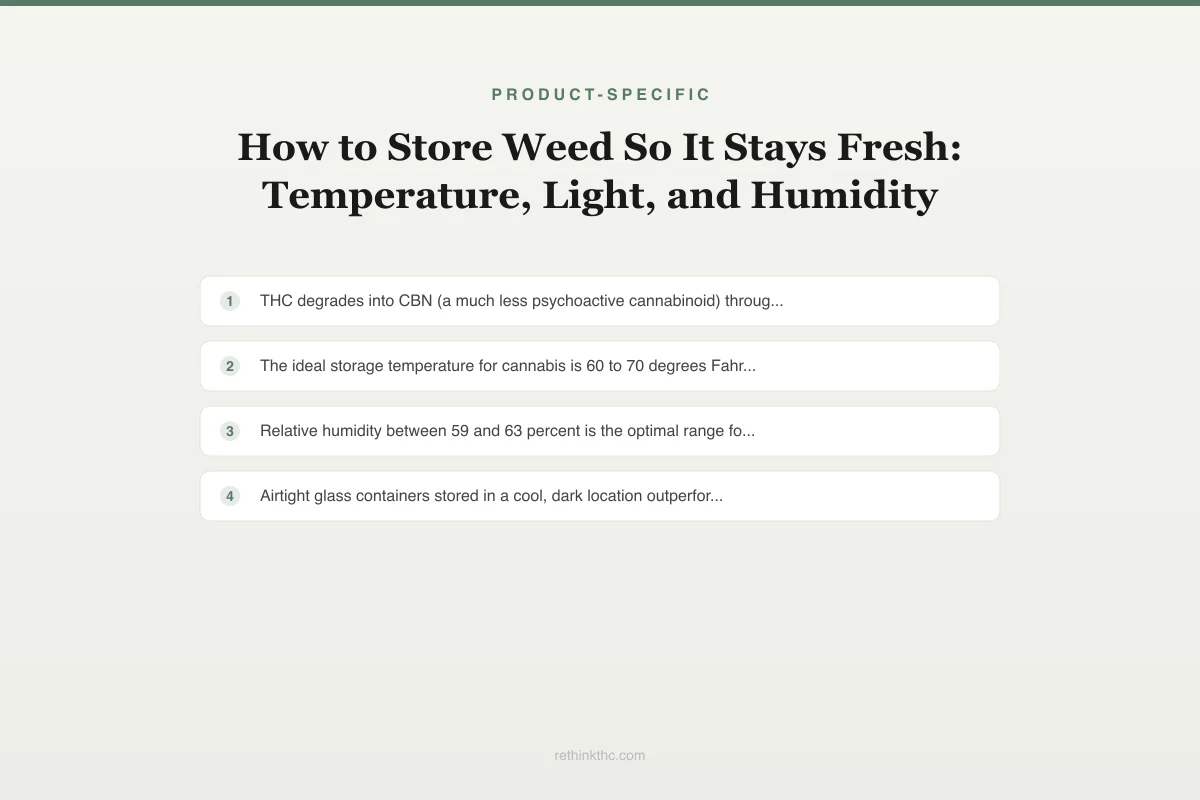
- THC breaks down into CBN — a much weaker cannabinoid — through oxidation and UV light exposure, and a 2019 study found that cannabis in clear containers lost up to 16 percent of its THC in just 100 days compared to opaque storage
- The sweet spot for storage temperature is 60 to 70 degrees Fahrenheit, because anything above 77 degrees speeds up terpene evaporation and invites mold — while freezing makes trichomes brittle enough to snap off
- Humidity between 59 and 63 percent keeps your weed in the safe zone — high enough to prevent it from drying out and getting harsh, but low enough to stop mold from growing
- An airtight glass jar in a cool, dark spot beats every other storage method — including plastic bags, silicone containers, and metal tins — because glass doesn't absorb anything and doesn't react with your cannabis
- Two-way humidity control packs like Boveda or Integra Boost are the easiest way to keep humidity dialed in — just drop one in a sealed jar and forget about it
- A 1999 University of Mississippi study in the Journal of Pharmacy and Pharmacology confirmed that light — especially UV wavelengths — destroys cannabinoids faster than heat or oxygen, so keeping your stash in the dark matters more than most people realize
How THC Degrades: The Chemistry You Need to Know
Cannabis Storage: Environment + Container Guide
THC does not simply vanish. It converts into other compounds, primarily through two chemical pathways: oxidation and photodegradation.
Oxidation occurs when THC is exposed to oxygen. The double bond in the THC molecule reacts with atmospheric oxygen over time, converting delta-9-THC into cannabinol (CBN). CBN is only mildly psychoactive, roughly one-quarter to one-tenth as potent as THC, and produces more sedating than euphoric effects. Cannabis that has been poorly stored for months and seems to make you sleepy rather than high is likely rich in CBN relative to its original THC content.
A landmark 1976 study by Fairbairn and colleagues at the United Nations Office on Drugs and Crime found that cannabis stored at room temperature in the light lost approximately 5 percent of its THC content per month. In the dark, the rate was substantially slower. This research, while dated, has been broadly confirmed by more recent analytical chemistry studies.
Photodegradation occurs when UV light breaks molecular bonds in THC. Sunlight and fluorescent lighting contain UV wavelengths that accelerate the conversion of THC to CBN and other degradation products. A 1999 study published in the Journal of Pharmacy and Pharmacology by researchers at the University of Mississippi confirmed that light, particularly UV wavelengths, was the single most significant factor in cannabinoid degradation during storage.
A 2019 analytical study tracked THC levels in cannabis stored under different conditions over 100 days. Samples stored in clear glass containers in ambient light lost up to 16 percent of their THC, while samples stored in opaque containers in the dark retained significantly more of their original cannabinoid profile. The takeaway is unambiguous: keep your cannabis in the dark.
Terpene evaporation is the other half of the degradation story. Terpenes, the aromatic compounds responsible for cannabis flavor and aroma (and which contribute to the entourage effect), are volatile organic compounds. Many have boiling points below 100 degrees Celsius, meaning they slowly evaporate even at room temperature when exposed to air. Myrcene, limonene, linalool, and other dominant cannabis terpenes will gradually escape from improperly sealed containers, leaving flower that smells and tastes flat.
Temperature: The Goldilocks Zone
Temperature affects cannabis storage through multiple mechanisms simultaneously. Too warm accelerates every form of degradation. Too cold creates different problems.
The ideal range is 60 to 70 degrees Fahrenheit (15 to 21 degrees Celsius). This is cool enough to slow chemical degradation and terpene evaporation while being warm enough to avoid the issues associated with cold storage.
Above 77 degrees Fahrenheit (25 degrees Celsius), several problems accelerate. Terpenes evaporate faster as temperature rises, stripping flavor and aroma. The rate of THC-to-CBN conversion increases with temperature, following the basic Arrhenius relationship where chemical reaction rates roughly double for every 10 degrees Celsius of temperature increase. And critically, temperatures between 77 and 86 degrees Fahrenheit combined with humidity above 65 percent create ideal conditions for mold growth. Aspergillus, the most medically concerning mold found on cannabis, thrives in exactly this range.
Below 32 degrees Fahrenheit (0 degrees Celsius) introduces mechanical damage. Trichomes, the resin glands that contain cannabinoids and terpenes, become extremely brittle at freezing temperatures. The water content within the trichome stalks and heads freezes, expands, and can fracture the structures. Handling frozen cannabis causes trichome heads to snap off their stalks, essentially shaking off the most potent part of the flower. These broken trichome fragments end up as dust at the bottom of the container rather than on the surface of the bud where they belong.
There is a narrow exception for long-term storage: some cultivators use deep-freeze conditions (well below zero Fahrenheit) to preserve harvested cannabis for months, but this requires vacuum sealing to prevent moisture condensation during freeze-thaw cycles and extremely careful handling to avoid trichome breakage. This is a professional technique, not a practical approach for consumer storage.
Avoid temperature fluctuations. Even within the acceptable range, repeated cycling between warm and cool temperatures causes condensation inside sealed containers. When warm, moist air inside a jar cools, the water vapor condenses on the interior glass surface and on the cannabis itself. This localized moisture creates conditions for mold growth even when the ambient humidity is otherwise acceptable. A stable temperature in a cool closet or drawer is far better than a garage or car that swings between daytime heat and nighttime cool.
Light: The Most Underrated Storage Factor
Light exposure, specifically UV radiation, is the single most destructive environmental factor for stored cannabis. This is counterintuitive for many people who worry primarily about humidity and temperature but leave their stash in a clear jar on a windowsill or desk.
The 1999 University of Mississippi study established that light degraded cannabinoids faster than any other single variable tested. Cannabis stored in direct sunlight deteriorated rapidly, with measurable THC loss within days. Even ambient indoor lighting, particularly fluorescent lights that emit UV wavelengths, contributes to degradation over time.
Practical solutions are simple:
- Store cannabis in opaque containers. Amber or dark-colored glass jars block most UV light while still providing the benefits of glass (nonporous, airtight, inert).
- If you use clear glass jars, keep them inside a drawer, cabinet, or closet where they are not exposed to light except when you open the drawer.
- Never leave cannabis on a countertop, desk, or windowsill in any container. The cumulative light exposure over days and weeks is significant.
- Avoid displaying cannabis in decorative clear containers. It looks nice for about a week and then you have accelerated the degradation of everything inside.
Light control is the cheapest and easiest storage improvement you can make. A dark drawer costs nothing.
Humidity: The Mold Threshold and the Brittle Threshold
Humidity control is where cannabis storage becomes a genuine balancing act. Too much moisture breeds mold. Too little moisture makes flower crumbly, harsh, and unpleasant to smoke.
The target range is 59 to 63 percent relative humidity (RH). This range was established through practical experience in the cannabis industry and is broadly supported by microbiology research on the moisture requirements of common cannabis-colonizing fungi.
Above 65 percent RH, mold growth becomes likely. The most common cannabis molds, including Aspergillus, Botrytis, and Penicillium, have minimum water activity requirements that correspond to roughly 65 to 70 percent RH. Once surface moisture reaches this level, dormant spores (which are ubiquitous in the environment) begin germinating and establishing colonies. You may not see visible mold for days or even weeks, but the biochemical clock starts ticking as soon as humidity crosses the threshold.
Below 55 percent RH, cannabis becomes overly dry. The flower loses its springiness and begins to crumble when handled. Trichomes become brittle and break off easily. Terpenes evaporate faster from desiccated plant material. Smoking or vaping overly dry cannabis produces harsh, hot vapor or smoke because the lack of moisture means faster and hotter combustion. The experience is unpleasant regardless of the remaining THC content.
Two-way humidity control packs are the simplest solution. Products from Boveda and Integra Boost are small packets containing a saturated salt solution that either absorbs or releases moisture to maintain a specific RH level inside a sealed container. The 62 percent Boveda pack and the 62 percent Integra Boost pack are the two most common options for cannabis storage.
These packs work passively and require no monitoring. Drop one into your sealed glass jar, and the humidity inside the jar will stabilize at the target RH regardless of ambient conditions. Replace the pack when it becomes stiff and hard (Boveda) or when the indicator dot changes color (Integra Boost), typically every two to four months depending on conditions.
A small digital hygrometer that fits inside your storage jar provides verification if you want to confirm your humidity is in range. These are available for under ten dollars and are worth the investment for anyone storing cannabis for more than a few weeks.
Container Choices: What Works and What Does Not
Not all containers are created equal. The material, seal quality, and design of your storage container directly affect how well it controls the variables discussed above.
Glass mason jars (the gold standard). Borosilicate or standard soda-lime glass is nonporous, chemically inert (it does not react with or absorb cannabinoids or terpenes), and can be sealed airtight with a proper lid. Wide-mouth mason jars in pint or half-pint sizes are ideal for most personal storage quantities. Amber or UV-blocking glass is preferable to clear glass but not strictly necessary if the jar is stored in the dark.
Plastic bags (avoid). Ziplock bags, sandwich bags, and other plastic bags are the most common cannabis storage method and also one of the worst. Plastic is porous at the molecular level, meaning air and moisture slowly pass through the material even when the bag is sealed. Plastic generates static electricity, which physically pulls trichomes off bud surfaces and deposits them as dust on the bag interior. Plastic can also leach chemicals into the cannabis over time. Terpenes, being organic solvents, can interact with certain plastic polymers.
Silicone containers (mixed). Silicone is popular for concentrate storage but suboptimal for flower. Silicone is gas-permeable, meaning it allows oxygen and terpene molecules to pass through the material. It does not generate the static charge that plastic does, but it also does not provide the airtight seal of glass. Silicone is fine for short-term storage of concentrates but should not be used for long-term flower storage.
Metal tins (acceptable). Tin or stainless steel containers with rubber-gasket lids can provide a decent seal and are lightproof. However, metal can impart flavors to cannabis over extended storage, and the seal quality varies significantly by manufacturer. They are better than plastic bags but worse than glass.
Vacuum-sealed bags (specialized). Vacuum sealing removes most of the oxygen from the storage environment, dramatically slowing oxidation. This is an excellent approach for long-term storage of large quantities. The downsides are that vacuum sealing compresses the buds (causing trichome damage and changing the physical structure of the flower) and that opening the bag to access the cannabis defeats the purpose. Vacuum sealing is best for cannabis you plan to store for months without accessing it.
Common Mistakes That Accelerate Degradation
Beyond the major factors of temperature, light, and humidity, several common practices speed up cannabis degradation.
Grinding flower in advance. Pre-ground cannabis has enormously more surface area exposed to air, light, and moisture compared to whole buds. The increased surface area accelerates every form of degradation simultaneously, including oxidation, terpene evaporation, and moisture exchange. Grind only what you plan to use immediately.
Storing in a car. Cars experience extreme temperature swings, from scorching in summer sunlight to freezing on winter nights. The interior of a parked car in summer can exceed 140 degrees Fahrenheit, which will rapidly degrade cannabinoids and terpenes and can even decarboxylate THCA to THC (and then further degrade the THC to CBN). Winter cold creates the trichome brittleness problems discussed above.
Opening the container frequently. Every time you open a storage container, you exchange the controlled atmosphere inside with ambient air, introducing fresh oxygen and potentially changing the humidity level. If you access your cannabis multiple times daily, consider keeping a small amount in a daily-use container and the bulk in a separate, less-frequently-opened storage jar.
Storing near heat sources. Near a stove, radiator, heating vent, or electronics that generate heat. Even moderate heat from a game console, computer, or lamp can raise the local temperature enough to accelerate degradation if the cannabis is stored nearby.
Mixing old and new cannabis. Adding fresh flower to a container that holds older flower introduces moisture differentials and can disturb the humidity equilibrium. If your older cannabis is properly stored at 62 percent RH and you add freshly purchased flower that is at a different moisture level, the humidity inside the container will shift, potentially pushing it outside the safe range.
How Long Properly Stored Cannabis Lasts
With optimal storage conditions, cannabis flower can maintain most of its potency and flavor for six months to a year. Beyond a year, even well-stored flower will show noticeable degradation in terpene complexity and some THC-to-CBN conversion, though the product remains usable.
As a rough timeline under ideal conditions (airtight glass, 60-70 degrees Fahrenheit, dark, 59-63 percent RH):
- 0-3 months: Minimal degradation. Flower should be essentially indistinguishable from fresh product.
- 3-6 months: Slight reduction in terpene complexity. You may notice the aroma is somewhat less vibrant. THC content remains largely intact.
- 6-12 months: Noticeable terpene loss and beginning of measurable THC conversion to CBN. The cannabis will still be effective but may feel slightly different in character, potentially more sedating.
- 12+ months: Progressive quality decline. Still consumable and still psychoactive, but increasingly removed from the original experience. At this point, the question becomes whether the remaining quality justifies continued storage.
Under poor conditions (plastic bag, room temperature, ambient light), the same timeline compresses dramatically. Significant degradation can occur within weeks, and mold risk becomes a concern within days in humid environments.
The Bottom Line
Cannabis storage is not complicated, but it does require intention. The science is clear: dark, cool, airtight, and humidity-controlled conditions preserve cannabinoids and terpenes while preventing mold. A ten-dollar glass jar, a two-dollar humidity pack, and a dark drawer is the entire setup. It takes less than a minute to implement, and the difference in product quality over weeks and months is substantial.
The most expensive cannabis in the world is worthless if it is stored in a plastic bag on a sunny windowsill. And reasonably priced flower stored properly will outperform poorly stored premium product every time. Storage is the variable that separates consistent quality from inconsistent disappointment.
The Bottom Line
Science-backed cannabis storage guide covering all four degradation factors. THC degradation chemistry: oxidation converts THC→CBN (1/4 to 1/10 potency, more sedating); 1976 Fairbairn UNODC study: ~5% THC loss/month in light, slower in dark; 1999 U of Mississippi J Pharm Pharmacol: UV light is single most significant degradation factor; 2019 study: clear containers lost up to 16% THC over 100 days vs opaque. Terpene evaporation: monoterpenes (myrcene bp 332°F, limonene 349°F, pinene 311°F) evaporate first; 30-55% lost during standard drying/curing; heavier sesquiterpenes persist. Temperature: ideal 60-70°F; above 77°F accelerates degradation per Arrhenius relationship + mold risk; below 32°F causes trichome brittleness/breakage; avoid fluctuations (condensation). Light: UV most destructive; opaque/amber glass or dark storage; never windowsill/counter. Humidity: 59-63% RH optimal; above 65% = mold (Aspergillus, Botrytis, Penicillium); below 55% = brittle trichomes, harsh smoke; Boveda/Integra Boost 62% packs. Containers ranked: glass mason jars (gold standard) > metal tins > vacuum-sealed bags (compresses buds) > silicone (gas-permeable) > plastic bags (worst — porous, static, chemical leaching). Common mistakes: pre-grinding, car storage (140°F+), frequent opening, heat sources, mixing old/new. Timeline under ideal conditions: 0-3 months minimal, 3-6 slight terpene loss, 6-12 noticeable decline, 12+ progressive.
What is the best container for storing cannabis?
Glass mason jars with properly sealing lids are the gold standard. Glass is nonporous, chemically inert (it does not react with or absorb cannabinoids or terpenes), and provides an airtight seal. Wide-mouth pint or half-pint sizes work well for personal quantities. Amber or UV-blocking glass is ideal but not necessary if the jar is stored in the dark. Avoid plastic bags (porous, generate static that pulls off trichomes, can leach chemicals), silicone containers (gas-permeable, poor for long-term storage), and standard zip-lock bags (inadequate seal, static damage). A glass jar with a Boveda 62% humidity pack in a dark drawer is the complete storage solution.
Should you store cannabis in the refrigerator?
Not unless you vacuum-seal it first. The refrigerator's defrost cycle creates temperature fluctuations that cause condensation inside sealed containers — exactly the kind of moisture exposure that promotes mold growth. Every time you open the fridge, temperature changes, and every defrost cycle creates additional condensation risk. A cool, dark closet or drawer at 60 to 70 degrees Fahrenheit with stable temperature provides better conditions than a refrigerator for most cannabis storage. If you must refrigerate (for example, in a very warm climate with no cool storage options), vacuum-seal the cannabis first and let it reach room temperature inside the sealed bag before opening to prevent condensation.
How long does weed stay good in a plastic bag?
Significantly shorter than in proper storage. Plastic bags are porous at the molecular level, meaning air and moisture pass through even when sealed. They also generate static electricity that physically pulls trichomes off bud surfaces, depositing them as dust on the bag interior — those are cannabinoids and terpenes you are losing. Cannabis in a plastic bag at room temperature can show noticeable degradation in flavor and potency within weeks, compared to months in an airtight glass jar. If a plastic bag is your only option, use it for days at most, not weeks. Transfer to glass as soon as possible.
Does pre-ground cannabis lose potency faster?
Yes, dramatically. Ground cannabis has enormously more surface area exposed to air, light, and moisture compared to whole buds. This accelerates every form of degradation simultaneously: THC oxidation to CBN proceeds faster with more oxygen contact, terpenes evaporate more quickly from the increased surface area, and moisture exchange happens more rapidly. Ground cannabis stored in a grinder for days or weeks will lose noticeable potency and flavor compared to intact buds under identical conditions. Only grind what you plan to consume in a single session, and if you must store ground cannabis, transfer it to a small airtight container.
Are Boveda packs safe to use with cannabis?
Yes. Boveda and Integra Boost humidity control packs are specifically designed for cannabis storage and are widely used in both commercial and personal storage. They use food-safe ingredients — Boveda packs contain a saturated salt solution in a permeable membrane — to create a two-way humidity control system that both absorbs excess moisture and releases moisture when the environment is too dry. They do not add chemicals, flavors, or any foreign substances to the cannabis. The packs cost a few dollars each and last 2 to 4 months in a sealed jar. Given that the cannabis they protect may be worth significantly more, the investment is easily justified.
Can you store different strains together in the same jar?
You can, but the terpene profiles will merge over time. Terpenes are volatile compounds that evaporate and redistribute within a sealed container. If you store a citrusy limonene-dominant strain with a piney pinene-dominant strain, the aromas will blend and each strain will lose its distinctive character. There is no safety concern, and the THC will not degrade differently. The only issue is flavor and aroma purity. If you value the distinct profiles of different cultivars, store them in separate containers. If you do not mind the terpenes blending, combining them in one jar is fine — just ensure the container is appropriately sized to minimize excess air space.
Sources & References
- 1RTHC-01233·Newmeyer, Matthew N et al. (2016). “How Long Cannabis Stays in Your Blood Depends on How You Consume It.” Clinical chemistry.Study breakdown →PubMed →↩
- 2RTHC-01523·Smart, Rosanna et al. (2017). “Inside Washington State's Legal Cannabis Market: THC Levels, Prices, and the Rise of Concentrates.” Addiction (Abingdon.Study breakdown →PubMed →↩
- 3RTHC-01543·Vandrey, Ryan et al. (2017). “Eating Cannabis Produces Much Lower Blood THC Levels Than Smoking, with Effects Peaking at 1.5-3 Hours and Lasting 6-8 Hours.” Journal of analytical toxicology.Study breakdown →PubMed →↩
- 4RTHC-00092·ElSohly, M A et al. (2000). “THC Potency in Confiscated Marijuana Rose From Under 1.5% in 1980 to 4.2% in 1997.” Journal of forensic sciences.Study breakdown →PubMed →↩
- 5RTHC-00939·Cone, Edward J et al. (2015). “Non-smokers exposed to secondhand cannabis smoke tested positive for THC in blood and oral fluid for up to 3 hours.” Journal of analytical toxicology.Study breakdown →PubMed →↩
- 6RTHC-00940·Cone, Edward J et al. (2015). “Secondhand cannabis smoke rarely caused positive urine tests at standard cutoffs, but did at lower thresholds.” Journal of analytical toxicology.Study breakdown →PubMed →↩
- 7RTHC-00981·Herrmann, Evan S et al. (2015). “Room ventilation dramatically reduced secondhand cannabis smoke effects on cognition, mood, and drug test results.” Drug and alcohol dependence.Study breakdown →PubMed →↩
- 8RTHC-00360·Hunault, Claudine C et al. (2009). “Higher THC Doses Caused Greater Cognitive and Motor Impairment in a Dose-Dependent Pattern.” Psychopharmacology.Study breakdown →PubMed →↩