Anxiety Science
4%
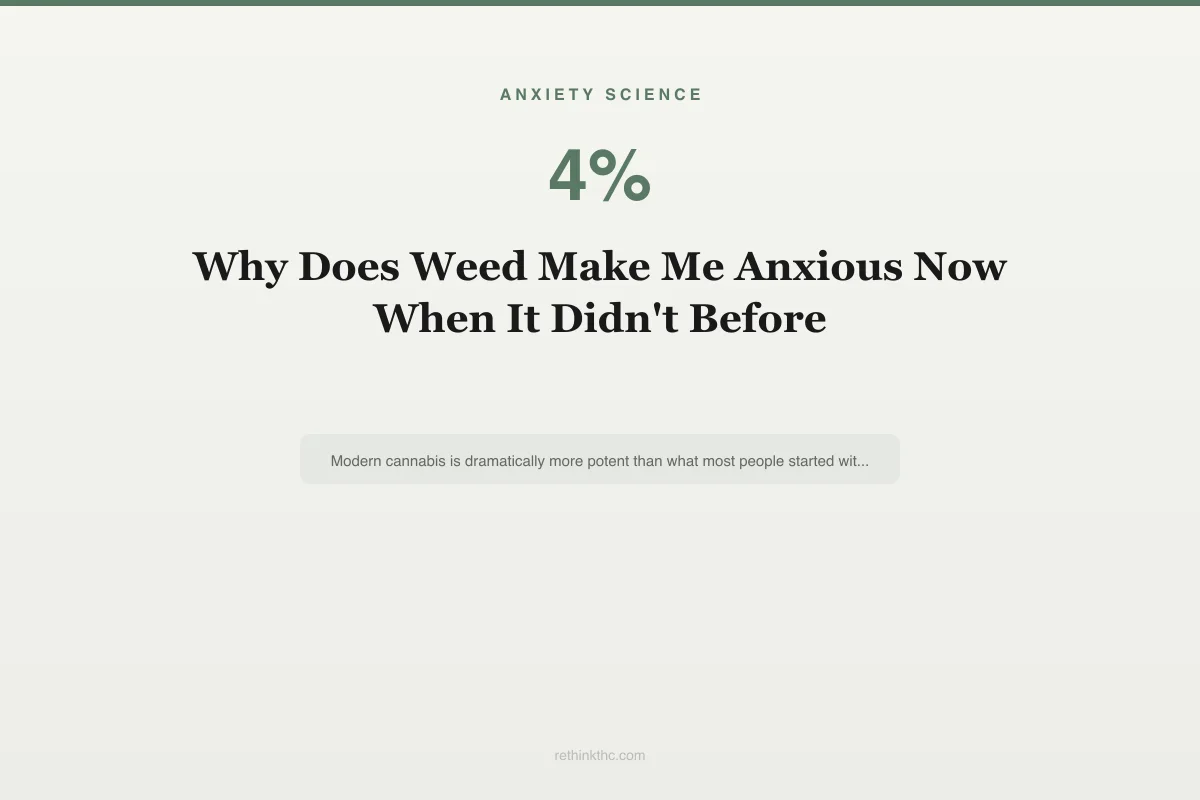
Average THC potency has surged from 4% in the 1990s to 20-30% today, and that shift combined with CB1 receptor changes from chronic use explains why cannabis that once relaxed you now triggers anxiety.
Drug and Alcohol Dependence, 2012
4%
Today's cannabis is far stronger than what most people
CB1 Receptor Changes from Chronic Use
covered in detail
Your Baseline Anxiety Changed
covered in detail
Drug and Alcohol Dependence, 2012
 View as image ↗
This is one of the most common and confusing experiences cannabis users describe. You used to love weed. It relaxed you, made you creative, helped you sleep, enhanced social situations. Then somewhere along the way, it changed. Now when you use cannabis you feel your heart racing, your thoughts spiraling, a sense of dread settling in. The same substance that used to be your off-switch has become a panic button.
You did not imagine the shift. It is real, it is common, and it has specific neurobiological explanations. The frustrating part is that there is usually not one single cause. It is typically a convergence of several factors, some related to your brain changing, some related to your cannabis changing, and some related to your life changing. Understanding each one can help you figure out what happened and, potentially, what to do about it.
Key Takeaways
- The shift from weed being relaxing to anxiety-inducing is extremely common, and it has real neurobiological causes — including changes in CB1 receptor density that happen with chronic use
- THC has a two-phase relationship with anxiety: low doses calm you down, while higher doses trigger anxiety through the amygdala — and your personal threshold between those zones shifts over time
- Life stress physically rewires the endocannabinoid system by lowering anandamide levels in the amygdala, which changes the chemical backdrop THC is working against
- Today's cannabis is far stronger than what most people started with — THC in flower has gone from about 4% in the 1990s to 20 to 30% now — so many users are unknowingly pushing past their anxiety threshold
- One bad experience can create a conditioned fear response in the amygdala that makes every session after it feel worse
- The shift often lines up with an underlying anxiety disorder that was previously mild enough to go unnoticed but has since gotten worse
The Biphasic Dose-Response: Your Threshold Moved
Why Weed Makes You Anxious Now: 5 Threshold Shifts
The 5 mg gap: A 2017 study found that 7.5 mg THC reduced stress-task anxiety while 12.5 mg increased it. Your threshold between relaxation and distress may have moved, not the drug.
The most fundamental concept for understanding this shift is that THC has a biphasic relationship with anxiety. This means low and high doses produce opposite effects.
At low doses, THC activates CB1 receptors in the prefrontal cortex and ventral striatum in a way that reduces anxiety. It enhances GABA signaling (the brain's primary inhibitory neurotransmitter), promotes dopamine release in reward circuits, and mimics the calming effects of your natural endocannabinoid anandamide. This is the relaxing, anti-anxiety effect that drew most people to cannabis in the first place.
At higher doses, THC activates CB1 receptors in the amygdala and other threat-detection circuits to a degree that overwhelms the calming effect. The amygdala becomes hyperreactive, the prefrontal cortex loses its ability to modulate the fear response, and norepinephrine (the fight-or-flight neurotransmitter) surges. The result is anxiety, paranoia, and sometimes full-blown panic.
The critical question is: where is the threshold between the relaxing dose and the anxiety dose? And the answer is that this threshold is not fixed. It moves based on your receptor state, your baseline anxiety level, your stress hormone profile, and other factors. What once sat comfortably in the low-dose relaxing zone may now be above your anxiety threshold, even if the actual milligrams of THC have not changed.
A 2017 study by Childs and colleagues at the University of Chicago, published in Drug and Alcohol Dependence, demonstrated this biphasic pattern directly. Participants given 7.5 mg of THC reported decreased negative emotional responses to a stress task, while those given 12.5 mg reported increased anxiety and negative mood. A 5 mg difference separated relaxation from distress.
CB1 Receptor Changes from Chronic Use
If you have been using cannabis regularly for months or years, your CB1 receptor landscape has changed significantly since you started.
Chronic THC exposure causes CB1 receptor downregulation, your brain reduces the number of active CB1 receptors on the cell surface. This is the basis of tolerance, and it is why you need more to get the same effect over time. But the downregulation does not happen uniformly across all brain regions.
Research by Hirvonen and colleagues, published in 2012 in Molecular Psychiatry, used PET brain imaging to show that chronic cannabis users had significant CB1 receptor reductions, with the most pronounced downregulation in cortical regions (including the prefrontal cortex).[1] The degree of downregulation in limbic regions like the amygdala may differ.
This differential downregulation matters enormously for anxiety. If the prefrontal cortex (which provides top-down emotional regulation) loses more CB1 sensitivity than the amygdala (which generates fear responses), the balance shifts. The same dose of THC now produces relatively more amygdala activation and relatively less prefrontal regulation than it used to. The net result is that cannabis starts triggering anxiety instead of relieving it.
This is not a permanent change. Hirvonen's study also showed that CB1 receptors began recovering within days of abstinence and were largely normalized after 28 days.[1] But as long as you are actively using, the altered receptor landscape persists, and the anxiety-proneness it creates continues.
Your Baseline Anxiety Changed
People change over time, and life circumstances create chronic stress that physically alters the brain's anxiety circuits. The cannabis did not change. You did.
Job stress, relationship problems, financial pressure, health concerns, becoming a parent, or simply the accumulating weight of adult responsibilities can elevate your baseline anxiety level. This baseline shift is not just psychological; it involves measurable changes in the brain.
Chronic stress reduces anandamide levels in the amygdala and prefrontal cortex, as demonstrated by Hill and colleagues across multiple publications. Reduced anandamide means less natural endocannabinoid buffering of the stress response. It also means there are fewer endocannabinoids occupying CB1 receptors, which paradoxically could mean more binding sites available for THC, potentially intensifying its amygdala-activating effects.
Chronic stress also elevates baseline cortisol and norepinephrine levels, sensitizes the amygdala to threat cues, and reduces prefrontal cortex volume and connectivity. All of these changes push your anxiety threshold lower, meaning less additional stimulation is needed to trigger an anxiety response. The dose of THC that once added pleasant relaxation on top of a calm baseline now adds activation on top of an already-stressed system, tipping you over the edge into anxiety.
Many people who describe the cannabis-to-anxiety shift can identify a period of increased life stress that preceded it. They may not have connected the two because the stress built gradually while the cannabis anxiety seemed to appear suddenly. But the shift in baseline anxiety often explains the timing.
The Potency Problem
There is a straightforward pharmacological variable that many people overlook: the cannabis you are using today is almost certainly stronger than what you started with.
The average THC content in cannabis flower has risen dramatically over the past three decades. In the mid-1990s, confiscated cannabis samples averaged approximately 4% THC. By 2014, the average was around 12%. By the 2020s, dispensary flower commonly tests at 20-30% THC, and concentrates can exceed 80-90%.
If you started using cannabis when products contained 10% THC and are now using products at 25% THC, you are getting 2.5 times more THC per unit consumed, even if your usage behavior has not changed at all. You are taking the same size hit, but delivering substantially more THC to your brain, potentially pushing past the biphasic threshold from the anti-anxiety to the pro-anxiety dose range.
This potency escalation is compounded by the gradual disappearance of CBD from high-THC products. CBD modulates THC's effects by partially blocking CB1 receptors and reducing THC-induced amygdala activation. Research by Bhattacharyya and colleagues, published in 2010 in Neuropsychopharmacology, showed that CBD attenuated the anxiety and paranoia that THC produced. Historical cannabis strains contained meaningful amounts of CBD alongside THC, providing a built-in buffer. Modern high-THC strains have been bred to maximize THC at the expense of CBD, removing this natural safety valve.
Conditioned Anxiety: One Bad Experience Changes the Game
For some people, the shift from relaxing to anxiety-inducing cannabis can be traced to a single bad experience, a panic attack, a paranoid episode, a terrifying high that left a lasting mark.
This is not just a mental hang-up. It is classical conditioning operating in the amygdala. When you have a panic attack while high, your amygdala forms a strong associative memory linking cannabis (the cues of preparing and using it, the initial physical sensations of THC onset) with danger. The next time you use cannabis, those cues activate the amygdala's fear memory before the THC even reaches full effect.
This conditioned anxiety is self-reinforcing. The anticipatory anxiety raises your baseline arousal before the THC kicks in. The THC then amplifies the already-elevated anxiety through the mechanisms described earlier. This confirms the amygdala's fear association, strengthening the conditioned response. Each subsequent use makes the association stronger and the anxiety worse.
Research on fear conditioning and the endocannabinoid system, reviewed by Lutz and colleagues in a 2015 paper in Neuron, has shown that the endocannabinoid system is centrally involved in both the formation and the extinction of fear memories. Paradoxically, the endocannabinoid system is needed for fear extinction (unlearning fear associations), but THC's indiscriminate activation of this system may impair rather than help the extinction process, making it harder to "unlearn" the cannabis-anxiety association.
Unmasking an Underlying Anxiety Disorder
In some cases, the cannabis-anxiety shift does not represent a change in how cannabis affects the brain. Instead, it represents an underlying anxiety disorder that has crossed a clinical threshold.
Generalized anxiety disorder, social anxiety disorder, and panic disorder often develop gradually in early to mid-adulthood. Many people self-medicate with cannabis during the early, subclinical stages without realizing they have a developing anxiety condition. Cannabis initially masks or manages the symptoms, which is why it feels helpful at first.
As the underlying disorder progresses, the anxiety-generating circuits become more active and sensitive. At some point, the anxiety produced by THC's amygdala effects exceeds the relief provided by its prefrontal effects, and the net balance flips. Cannabis stops masking the anxiety and starts amplifying it.
This realization can be disorienting because the person may have been relying on cannabis as their primary anxiety management tool. Discovering that the tool has stopped working, or is making things worse, can create a sense of being stuck: anxious without cannabis because of the underlying disorder, anxious with cannabis because of the changed pharmacological response.
If this describes your experience, it may be worth pursuing an evaluation for an anxiety disorder independent of cannabis use. The anxiety may need to be addressed on its own terms, through therapy, medication, or other evidence-based approaches, rather than through cannabis.
What You Can Do About It
The shift from relaxing to anxious cannabis is not necessarily permanent, and several strategies may help if you want to continue using.
Reduce your dose significantly. Given the biphasic dose-response, the anxiety may be a dose issue rather than a fundamental incompatibility. Try using much less than you currently do, perhaps one-quarter to one-half of your usual amount, and see if the relaxing effect returns at the lower dose.
Seek out products with meaningful CBD content. A balanced THC-to-CBD ratio (1:1 or even 2:1) may restore the buffering effect that keeps THC in the anti-anxiety range. Pure CBD flower or a CBD tincture taken alongside THC can achieve a similar effect.
Take a tolerance break. A 2-4 week break allows CB1 receptors to normalize, potentially restoring the receptor balance between prefrontal and amygdala regions that produces a relaxing rather than anxious response.
Address the underlying stressors. If life stress is elevating your baseline anxiety, no amount of cannabis adjustment will fix the problem. Therapy, exercise, sleep improvement, and stress management can lower your baseline, potentially expanding the window where cannabis feels good rather than threatening.
Consider that you may have outgrown cannabis. This is a possibility people rarely want to hear, but for some, the neurobiological changes that accumulate over years of use and aging create a situation where the risk-reward ratio of cannabis has permanently shifted. Accepting this is not a failure; it is an honest assessment of a changed neurobiological reality.
The Bigger Picture
The shift from enjoyable to anxious cannabis highlights something important about all psychoactive substances: the effect is never just the drug. It is always the drug interacting with the brain it encounters. Your brain at 19 is not the same as your brain at 29 or 39. Your brain after a relaxing weekend is not the same as after a stressful work week. Your brain with dense, well-distributed CB1 receptors is not the same as after years of THC-driven downregulation.
Cannabis did not betray you. Your neurobiological context changed, and the drug's effect changed with it. Understanding why is the first step toward deciding whether to adapt your use, take a break, or move on.
The Bottom Line
Neurobiological explanation of cannabis-to-anxiety shift covering biphasic threshold movement, CB1 receptor changes, baseline anxiety, potency escalation, and conditioned fear. Biphasic dose-response: Childs 2017 Drug and Alcohol Dependence — 7.5mg THC decreased negative emotional responses, 12.5mg increased anxiety; 5mg separated relaxation from distress; threshold between zones shifts over time. CB1 receptor changes: Hirvonen 2012 Molecular Psychiatry PET — chronic use causes differential CB1 downregulation; prefrontal cortex loses more sensitivity than amygdala → same dose produces relatively more amygdala activation (fear) and less PFC regulation; recovers within 28 days abstinence. Baseline anxiety: chronic stress reduces anandamide in amygdala/PFC (Hill, multiple publications); elevated cortisol independently downregulates CB1; THC on stressed system tilts toward anxiety. Potency: average THC rose from ~4% (1990s) to 20-30% (2020s); 2.5x more THC per hit with same behavior; CBD bred out removes natural buffer; Bhattacharyya 2010 Neuropsychopharmacology — CBD attenuated THC-induced anxiety/paranoia. Conditioned anxiety: single bad experience → amygdala forms fear association with cannabis cues; Lutz 2015 Neuron — ECS involved in fear conditioning/extinction; THC may impair extinction process. Unmasking: underlying anxiety disorder crossing clinical threshold; cannabis stops masking, starts amplifying. Solutions: reduce dose, balanced THC:CBD ratios, tolerance break (2-4 weeks for CB1 normalization), address underlying stressors, consider outgrowing cannabis.
Why did weed suddenly start giving me anxiety?
The shift typically results from a convergence of factors rather than a single cause. Your CB1 receptor landscape changes with chronic use (differential downregulation between prefrontal cortex and amygdala shifts the balance toward fear), your baseline anxiety may have increased from life stress, cannabis potency has risen dramatically, and a single bad experience can create conditioned fear associations. The dose of THC that once sat in the relaxing range may now exceed your shifted anxiety threshold.
Can I fix cannabis anxiety without quitting?
Several strategies may help. Reduce your dose significantly — the biphasic threshold may be closer than you think, and even a 5mg difference separated relaxation from distress in Childs' 2017 study. Use products with balanced THC-to-CBD ratios, as CBD attenuates amygdala activation. Take a 2-4 week tolerance break to allow CB1 receptors to normalize. Address underlying life stressors that may be elevating your baseline anxiety. If none of these work, your neurobiological context may have shifted permanently.
Does a tolerance break help with cannabis anxiety?
Yes. Hirvonen's 2012 brain imaging study showed that CB1 receptors begin recovering within days of abstinence and largely normalize within 28 days. If differential receptor downregulation between the prefrontal cortex and amygdala is driving the anxiety, a tolerance break allows both regions to recover, potentially restoring the balance that produced a relaxing rather than anxious response. When returning after a break, start with a much lower dose than your pre-break amount.
Could my cannabis anxiety mean I have an anxiety disorder?
Possibly. Anxiety disorders often develop gradually in early to mid-adulthood, and many people unknowingly self-medicate with cannabis during the subclinical stages. As the underlying disorder progresses, the anxiety generated by THC's amygdala effects eventually exceeds the relief from its prefrontal effects. If cannabis consistently causes anxiety regardless of dose, product, or setting, an evaluation for generalized anxiety, social anxiety, or panic disorder independent of cannabis use may be warranted.
Is cannabis anxiety related to increased potency?
Significantly. Average THC in flower has risen from approximately 4% in the 1990s to 20-30% today. If you are taking the same size hit but the product contains 2.5 times more THC, you may be unknowingly exceeding the biphasic threshold from anti-anxiety to pro-anxiety dosing. Additionally, modern strains have been bred to maximize THC while minimizing CBD, removing the natural anxiolytic buffer that historical cannabis provided.
Can one bad experience permanently change how weed feels?
A single panic attack while high can create a conditioned fear response in the amygdala that makes subsequent use anxious. This is classical conditioning — your amygdala links cannabis cues with danger, triggering anticipatory anxiety before THC even takes full effect. The conditioned anxiety is self-reinforcing because each anxious session strengthens the association. However, it is not necessarily permanent. Careful re-exposure at very low doses in comfortable settings, combined with addressing the conditioned fear, may help extinguish the association over time.
Sources & References
- 1RTHC-00573·Hirvonen, Jussi et al. (2012). “Daily Cannabis Use Was Linked to Fewer CB1 Receptors. A Month Without Brought Them Back..” Molecular Psychiatry.Study breakdown →PubMed →↩